
By Angela Wilson | Thanks to U.S. visa programs, white South Africans are taking jobs from Black residents in Mississippi—and making more money.
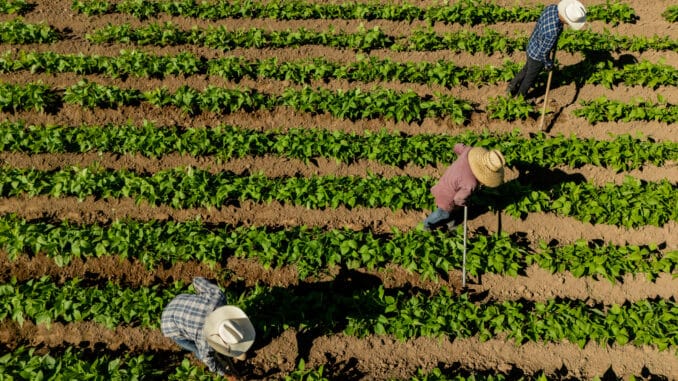
The change didn’t happen overnight in one historic Southern town, but it felt like it. It started with fewer farm engines turning over at dawn and a sudden, sharp decline in local Black farmers’ payrolls in Mound Bayou, Mississippi, as white men with thick accents were tapped to work the local fields, earning significantly higher wages than the residents they replaced.
In Mound Bayou—about two hours north of Jackson—the town’s soil carries a historic weight that few other places in America can claim. Founded in 1887 by former slaves and dubbed the “Jewel of the Delta,” the largest segregated African American town was a safe haven during the Jim Crow era where residents not only enjoyed independence, they governed themselves.
The town boasted thriving Black-owned businesses, the Taborian Hospital and the Bank of Mound Bayou, the only surviving historic commercial building in the Mississippi Delta.
Then came the newcomers. Under the federal H-2A via program, foreigners are supposed to be a last resort meant to fill seasonal gaps in the American workforce when domestic workers are unavailable. But in Mound Bayou, residents say the last resort has become the first choice. The previous decade relied on a steady stream of Mexican labor, that is until the Trump administration cracked down on immigration.
Between 2024-2025, some 25,000 South Africans have come to work on American farms alone, according to The Clarion-Ledger. Agricultural firms claim a labor shortage justifies the shift, yet for the Black families who have lived and worked the land for centuries, the math doesn’t add up.
Locals condemn the sudden pivot to white South African crews as blatant discrimination and intentional displacement. Some residents allege they have had to train their foreign replacements before being fired.
“I see it around here, I see these guys when I go to Walmart. They are usually wearing short pants and they speak in Afrikaans to each other. It doesn’t make sense to me economically,” Herman Johnson Jr., director of the Mound Bayou Museum of African American Culture and History said, The Clarion-Ledger reported.
He continued: “If you bring people in from another country to work on your farm and you’re paying them more, that means you have more going out from your pocket to them. A lot of things in a racial perspective that white supremacy does doesn’t make economic sense.”
Now, unemployment among Mound Bayou’s residents continues to soar, according to The Clarion-Ledger. While the H-2A program requires employers to prove they cannot find local workers before hiring internationally, critics allege misuse of this system—and they’re taking their complaints to court.
Five Black U.S. farmworkers from Mississippi sued Gregory Carr for allegedly discriminating against them in favor of white foreign workers and costing them thousands of dollars in unpaid wages, the Mississippi Center for Justice (MCJ) announced last May. In the federal lawsuit, they alleged Black farmhands were paid $10 while white South Africans earned more for the same work.
“The intentional underpayment and misclassification of Black farmworkers in favor of white foreign labor not only violates federal law but has become increasingly common in the Mississippi Delta, holding our communities back for generations and perpetuating the historical exploitation faced by Black agricultural workers in our community,” Kimberly Jones Merchant, President and CEO of the Mississippi Center for Justice, said.
The May 2025 lawsuit is the ninth case filed by the Southern Migrant Legal Services (SMLS) and the MCJ challenging alleged discriminatory practices of farmers in Mississippi. The MCJ said previous cases were settled with significant wage recoveries for local workers.
“This case shows how the H-2A program can be manipulated to exclude and underpay Black American workers,” said Marion Delaney of SMLS. “Federal protections are only meaningful if we enforce them– and that’s exactly what our clients are demanding through this lawsuit.”
Source:
https://www.theroot.com/white-supremacy-black-farmers-in-historic-miss-town-a-2000102144