
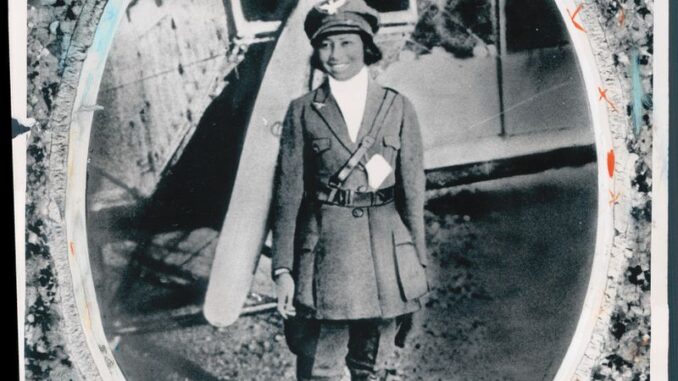
By Opio Lumumba Sokoni, JD | We Remember Queen Bess 100 Years Later | The shadow of a Curtiss JN-4 Jenny biplane against the Florida sky was the last thing Bessie Coleman ever saw. On April 30, 1926, the woman known to the world as “Queen Bess”—the first African American and Native American woman to hold an international pilot’s license—plummeted to her death in Jacksonville.
As the world marks the centenary of that tragic morning, the historical focus often remains on the wreckage in a field near Paxon Airfield. However, the true story of that day is also anchored in the streets of Jacksonville’s “Black Wall Street,” where a young businessman named John Thomas Betsch Sr. found himself at the center of a national media firestorm.
The Flight and the Fall
Bessie Coleman didn’t come to Jacksonville just to fly; she came to inspire. She was preparing for an exhibition sponsored by the Negro Welfare League, intended to raise funds and awareness for the Black community. On the day of the test flight, Coleman was scouting the terrain from the passenger seat, unbuckled so she could peer over the edge of the cockpit to locate the best site for a parachute jump.
When the plane suddenly accelerated, flipped, and pitched her into the air from 2,000 feet, the city of Jacksonville became the epicenter of a tragedy that devastated Black America.
A Prince in the Eye of the Storm
At the time, John Thomas Betsch Sr. was a 26-year-old rising star in Jacksonville’s professional circles. An employee of the Afro-American Life Insurance Company and a man deeply embedded in the civic life of the Sugar Hill neighborhood, Betsch had been instrumental in organizing the airshow and coordinating Coleman’s visit.
When the tragedy struck, the mainstream and Black press alike scrambled for details. Betsch, who had been on the ground and was intimately involved in the logistics of the event, was thrust into the headlines. For a harrowing period following the crash, he was even detained by local authorities as they investigated the mechanical failure—a loose wrench that had reportedly jammed the controls.
The media storm was relentless. From the Chicago Defender to the Associated Press, Betsch’s name became synonymous with the tragic end of an icon. Yet, in the face of intense scrutiny and personal grief, he remained a pillar of dignity, ensuring that the legacy of the pilot was protected even as the nation watched Jacksonville with a critical eye.
Beyond the Tragedy
While 1926 marked a dark chapter for Jacksonville and the Betsch family, it did not define them. John Thomas Betsch Sr. went on to become a titan of industry and a guardian of the community. His efforts helped build the institutions that allowed Black Jacksonville to thrive under the weight of segregation, from his work with the Afro-American Life Insurance Company to his involvement in the development of American Beach—a sanctuary where “relaxation without humiliation” was the standard.
The century that has passed since Coleman’s fall has not dimmed her brilliance, nor has it erased the memory of the man who stood by her mission in her final days. While the world remembers the pilot who reached for the stars, Jacksonville also remembers the man who kept the ground steady for his community.