
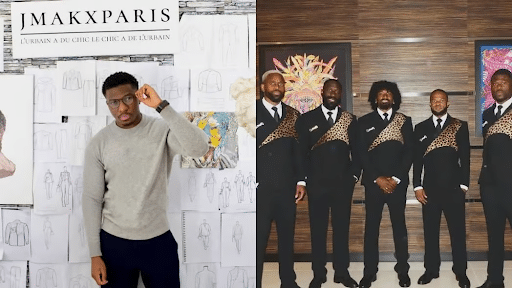
The viral looks were designed by Alvin Junior Mak, founder and creative director of JMAKxPARIS. Far from a simple pre-match outfit, the collection was conceived as a tribute to Congolese culture, the legendary 1974 Leopards squad, and the enduring influence of La Sape, one of the continent’s most celebrated fashion movements.
In a video in which he goes in-depth into the making of the look, Mak, who was born in the Democratic Republic of the Congo but raised in Paris, says the look overall needed to reflect “That of a generation that dares to dream big and believes in its country’s potential.”
La Sape, short for Société des Ambianceurs et des Personnes Élégantes (or “Society of Ambiance-Makers and Elegant People”), is a fashion subculture rooted in the neighboring Congolese capitals of Kinshasa and Brazzaville. Defined by its embrace of elegance, bold self-expression, and meticulous attention to dress, the movement treats style not merely as a matter of appearance but as a reflection of dignity, pride, and aspiration.
“Beyond sartorial elegance, I believe that Sape embodies above all a state of mind. Sape was a movement born in a working-class setting,” Mak explained. “It’s first and foremost a movement of humble people. What I’ve always loved about sape is the mindset that these people carry. They are people who don’t have much, but who fight to have beautiful things.”
That philosophy became the foundation of the Leopards’ arrival looks.
The designer said he wanted the outfits to communicate a message of ambition and possibility, one that transcends class or circumstance.
“It shows that it’s possible to rise through ambition, even if you come from a poor, humble or wealthy background,” he said.
He added, “It’s very important to have this mindset that we are capable of anything. You just need ambition and determination.”
Every design choice was made with that message in mind.
Mak selected black silk crepe for the suits, a color he associates with resilience, determination, and ambition. The velvet leopard-print lapel collar serves as both a visual focal point and a cultural reference. Given the leopard’s longstanding place in Congolese symbolism, he described the choice as “natural,” representing strength and identity across many communities.
“It was important to choose this silhouette while making sure it respects institutional attire and modern creativity,” the creative director said.
That balance between heritage and modernity is also reflected in how JMAKxPARIS described the ensemble.
Source: