
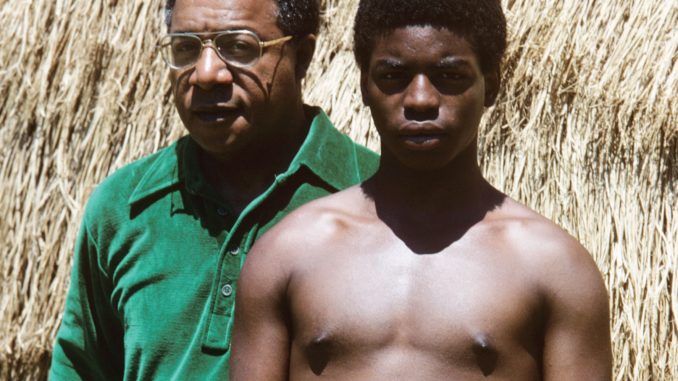

January 23, 1977 sees the premiere of Roots, a groundbreaking television program. The eight-episode miniseries, which was broadcast over eight consecutive nights, follows a family from its origins in West Africa through generations of slavery and the end of the Civil War. — Photo: Facebook
Fifty summers ago, in 1976, journalist and author Alex Haley published his masterwork, “Roots: The Saga of an American Family.”
The timing was exquisite: As the nation celebrated the bicentennial with fireworks and paeans to freedom, “Roots” countered it with a deeply personal, Black-centered narrative of American history that began in Africa and cast the horror of slavery as foundational, not incidental, to the country’s founding and its character.
“Roots” became one of more than 100 titles banned in Knox County schools, part of a wider effort sanctioned by the Trump administration to diminish or disappear Black history in public institutions. The outcry about the ban was so immediate and intense that school officials lifted it a few weeks later.
Some of that can be credited to pushback from Haley’s own family members. I’ve been friends for years with his niece, Anne Haley, a lawyer who has spent her career in the Los Angeles city attorney’s office. Anne, 64, grew up intimately acquainted with “Roots” first with the stories about an ancestor named Kinte she’d heard from her Uncle Alex, and with the dozen years it took him to produce a book that wove those stories into a singular account of the Africa-to-America experience.
“It hurt,” she said. “It was like going through the stages of grief. One was indignation — how dare you? “Roots” put Tennessee on the map!”
Alex Haley himself had roots in Tennessee, the place where he and his brothers, including Anne’s father, spent summers hearing stories about his African forebears from their grandmother. A towering bronze statue of Haley sits in Alex Haley Heritage Square in Knoxville.
Clinton, a town in the Knoxville metropolitan area, is where Alex Haley bought a farm and where, after “Roots” became a singular cultural phenomenon, he chose to return and live the remainder of his life; he died in 1992. (The farm was bought by the Children’s Defense Fund and turned into a center that, according to the website, grows justice.)
The single offending scene was a description of “my great-great-great-great-grandmother being raped by her enslaver. Not a unique circumstance,” Anne Haley said dryly.
As a Black story, “Roots,” for all of its acclaim, was always vulnerable to being de-classicized because in this country, the significance of Black people’s stories in the national narrative has never been a settled matter. To the contrary, they pose an ongoing challenge to the country to fulfill its own promises of fairness and equality. Right now the country is utterly failing to do that, and so “Roots” must fail too.
At the same time, “Roots” was fundamentally tough to watch, and sometimes to hear; I remember being startled by the liberal use of the N-word on primetime TV. Also, it was a revelation to see famous white actors I knew from mainstream family fare — Robert Reed from “The Brady Bunch,” Chuck Connors of “The Rifleman,” Sandy Duncan of “Peter Pan” fame — portraying slavers and racist Southerners so convincingly.
That, of course, made people uncomfortable. But discomfort was not the enemy back then. Indeed, it was the point.
“Roots” was part of a tradition of realistic ’70s filmmaking — including “The Deer Hunter,” “Taxi Driver,” “Midnight Cowboy” and “The Godfather” — that was gritty, straightforward and interested not in making America look good, but in exposing America to itself.
In Haley’s American family saga, a good many Americans saw for the first time the full saga of themselves, and of the country. And for a brief moment that created community.
Recalling that communal moment is why Anne said she has often had a hard time accepting the intentional divisiveness of this one. She is encouraged by the continued resistance against Black erasure, including the pushback that forced Knox County schools to rescind the ban.
“Uncle Alex always said, ‘Find the good and praise it,’” she said. The lesson for her, especially given the fact that “Roots” was inspired by one family’s oral history, is that Black people must keep telling their stories.
“My hope is to make people realize, especially Black people, that we need to coalesce,” she said. “We need to remain a village. We need to reinstitute the village.”
Erin Aubry Kaplan examines the persistent barriers to racial justice and opportunities for progress in an era of receding Black presence in Los Angeles and California for Capital & Main, a nonprofit publication focused on inequality. It is published here with permission.