
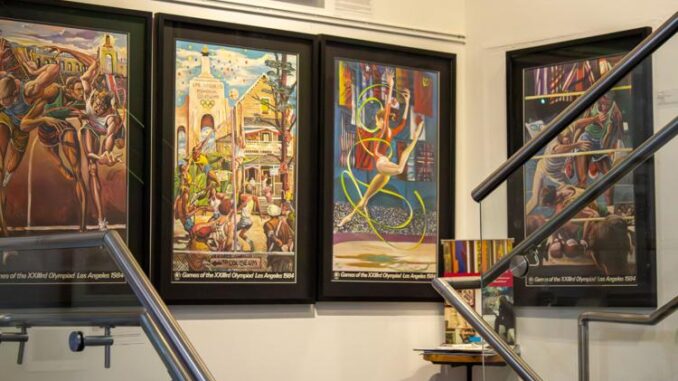
From June until October 2026, Hampton Art Lovers is presenting In the Paint: Ernie Barnes and the Art of the Game, a companion exhibition to the Pérez Art Museum Miami’s Get in the Game: Sports, Art, Culture. The Hampton Art Lovers exhibition is drawn from The Norwood Collection and can now be viewed at the Historic Ward Rooming House Gallery in Overtown.
Featuring more than 30 works and artifacts, In the Paint explores the intersection of athletics, performance, rhythm and identity through the work of celebrated artist and former NFL football player Ernie Barnes. It examines sports through the lens of competition and choreography, inviting visitors to consider how athletic achievement has helped shape the narratives around Black creativity.
Curated by Chris Norwood, the exhibition centers around some of Barnes’ iconic works, including selections from Portfolio of Football Art, as well as Barnes’ celebrated Olympic imagery and individual works like the famous Dream Unfolds, dated circa 1996.
Norwood emphasized the aspirational nature of Barnes’ art, where dreams and reality overlap.
“Ernie Barnes explores this idea through the language of movement and elevation,” said Norwood. “The work celebrates not merely achievement but aspiration itself. The figures depicted are engaged in this process of becoming… that process of transforming effort into opportunity and potential into accomplishment.”
According to Norwood, Barnes considers athletic achievement as a form of personal and collective imagination. “The athlete becomes a simple possibility, reminding us that success is rarely accidental,” he said.
Last week’s opening reception of In the Paint drew a diverse crowd of art lovers, sports fans and community advocates. One attendee, a multidisciplinary artist that goes by the mononym NICOLA, became familiar with Barnes’ work while she was a student at the University of Central Florida. In her own work, she aims to depict her personal experiences, and she sees that ethos reflected in Barnes.
“Especially with the World Cup going on, [Barnes’ work] is still relevant to today, though you may not think of it initially,” said NICOLA. “I had never seen his work in context, which is what it was created for. I think it’s really interesting to have that experience with other people.”
NICOLA’s cousin Danielle St. Luce also attended the event. A consultant who helps asset allocators make investments in their neighborhoods, she often works within Black spaces to elevate the local community.
“I know Chris, and he’s always done really wonderful, upscale work,” said St. Luce. “We needed something downtown that was a Black art presence and also educational, and Chris has done that.”
As one of the preeminent 20th century Black artists, Barnes explores sport as a unifying factor. Natalya Sangster, arts advocate and director of operations at the Southeast Overtown Park West CRA, argues that even those who aren’t versed in athletics can make connections with Barnes’ work.
“Movement is really important,” said Sangster. “We may not look at sports as art, but it is; how the people work together, how they contribute, how they communicate on the field — that is an art. There’s a skill and a talent, and so for someone like me who’s not really familiar with sports, that makes a connection.”
For Norwood, creating that connection between art and the Black community is of utmost importance. He describes a “barrier” between Black people and traditional museum spaces and highlights his intent to utilize his exhibition as a conduit to get people to have conversations that they wouldn’t have otherwise.
Norwood spoke plainly about the effects of the Transatlantic Slave Trade on Black art. As a result of displacement, the conscious appreciation for the creation of visual art was lost. While music persevered through 400 years of chattel slavery, visual art became nearly impossible to practice
“I think that’s a part of why sometimes there’s this barrier between us and the museums —because we look at the people who appreciate visual art as people who are not us,” said Norwood. “But, in fact, it is us. We just don’t recognize that our appreciation for visual art is very much just a part of our every day.”
In addition to the portion dedicated to Barnes, the exhibition also features three historic gelatin silver prints by renowned sports photographer Herb Scharfman and a special section devoted to Paul Robeson, an athlete, singer, scholar and activist.
Norwood hopes that his exhibition can be a bridge to the companion show at the PAMM. In the Paint reflects the ongoing mission of Hampton Art Lovers to accentuate African American art and culture in a city that serves as a global gathering place.
“More people should be coming here,” said St. Luce. “You come here, you have community here, and it’s nice to have places where you can come back and you feel like you’re home.”
In the Paint is free and open to the public, available for viewing by RSVP from Thursday to Sunday through October 2026. Find out more about Hampton Art Lovers and the current exhibition by going to hamptonartlovers.eventbrite.com.
Source: