

Republicans enter the 2026 election cycle with a 53–47 majority in the U.S. Senate, giving the party a structural advantage as Democrats attempt to reclaim control of the chamber. To flip the Senate outright, Democrats must net four seats, or gain three to force a 50–50 split with the vice president casting tie-breaking votes.
The path forward, however, remains uncertain. The electoral map is still taking shape, with several key races lacking defined matchups and candidate fields continuing to evolve. In multiple battlegrounds, Democrats are defending existing seats while also searching for offensive opportunities in Republican-held territory.
Among the most closely watched races is Georgia, where incumbent Jon Ossoff is expected to seek reelection after his narrow 2021 runoff victory. The state remains highly competitive, and Republicans are likely to mount a strong challenge in what could again become one of the nation’s tightest contests.
Michigan presents another potential battleground, particularly if Sen. Gary Peters opts not to run again. Democratic figures such as Mallory McMorrow and Haley Stevens have been discussed as possible successors, while Republicans are expected to aggressively contest the seat regardless of the final lineup.
In North Carolina, Republican Sen. Thom Tillis faces reelection against Gov. Roy Cooper, though no formal matchup has been finalized. Maine remains a perennial swing state, where Sen. Susan Collins has historically defied political headwinds but is expected to face another strong Democratic challenge.
Additional states, including Ohio, Texas, Alaska and Louisiana, are on the radar, though most lean Republican. In Texas, Sen. John Cornyn faces a high-profile primary challenge from Attorney General Ken Paxton, a contest that could influence the general election depending on its outcome.
Florida Emerges as a Political Flashpoint
Beyond the Senate map, Florida is poised to play a pivotal role in shaping the national political landscape, particularly with its 2026 gubernatorial race. With term limits preventing

Gov. Ron DeSantis from seeking reelection, the contest for governor is expected to draw significant attention and resources from both parties.
Republicans are likely to maintain a strong position in the state, but Democrats are eyeing the open seat as a potential opportunity to regain ground in a state that has trended red in recent cycles. The race could feature a mix of established political figures and emerging candidates, with issues such as economic affordability, education policy, and voting rights expected to dominate the debate. As Florida prepares for an open gubernatorial race in 2026, two potential contenders—U.S. Rep. Byron Donalds and former U.S. Rep. David Jolly—are emerging as early focal points in what could become a closely watched and ideologically defined contest. Orange County Mayor Jerry Demings has also formally entered the 2026 race for governor.
Donalds, a Republican representing Southwest Florida in Congress, has built his profile as a staunch conservative aligned with the party’s right flank. A member of the House Freedom Caucus, he has emphasized limited government, lower taxes and opposition to what he characterizes as federal overreach. He has also been a vocal supporter of former President Donald Trump, a relationship that could bolster his standing in a Republican primary. Donalds frequently highlights issues such as border security, parental rights in education and economic opportunity, messaging that mirrors broader Republican priorities in Florida.
Jolly, a former Republican congressman from the Tampa Bay area who later became an independent and aligned with Democrats, represents a markedly different political trajectory. In recent years, he has emerged as a critic of the modern Republican Party, positioning himself as a centrist voice focused on bipartisanship and institutional reform. Now running as a Democrat, Jolly is expected to emphasize issues such as voting rights, health care access and political accountability. He has also spoken about the need to move beyond partisan polarization, framing his candidacy as an appeal to moderates and disaffected voters across party lines.
Jolly’s background as a former Republican could help him attract independent voters, though it may also present challenges in consolidating Democratic base support in a primary.
Demings, a longtime Central Florida figure, brings a résumé rooted in both law enforcement and executive leadership. He previously served as Orlando’s police chief, Orange County sheriff and, since 2018, mayor of Orange County—one of the state’s largest and most reliably Democratic regions. His campaign centers on affordability, public safety and restoring local control.
All of the candidates face hurdles before a general election matchup becomes reality. Donalds would need to navigate a potentially crowded Republican primary, while Jolly must secure the Democratic nomination in a state where the party has struggled in recent statewide races. Demings enters a competitive Democratic primary where Jolly has already built early momentum. Initial polling shows Jolly with a slight lead, though a majority of voters remain undecided, underscoring the fluid nature of the race.
Florida’s importance extends beyond its borders. A competitive gubernatorial race could influence voter turnout, shape down-ballot contests, and indirectly affect Senate and House races nationwide.
A Historic Wave of Black Women Candidates
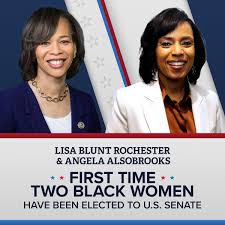 One of the most significant developments of the 2026 cycle is the growing number of Black women entering or exploring Senate bids across the country, signaling a shift in political representation and candidate diversity.
Historically, only five Black women have served in the U.S. Senate. Currently, two—Angela Alsobrooks and Lisa Blunt Rochester—are serving simultaneously for the first time. That milestone could expand in 2026.
In Illinois, Lt. Gov. Juliana Stratton and Rep. Robin Kelly are both viewed as potential contenders should a Senate seat open, raising the possibility of a historic primary in a solidly Democratic state. Kentucky’s Pamela Stevenson has entered the race, while in Mississippi, Priscilla Williams-Till is challenging incumbent Sen. Cindy Hyde-Smith.
Other early candidates include Catherine Fleming Bruce in South Carolina and N’Kiyla Jasmine Thomas in Oklahoma, though both states present steep challenges for Democrats. In Minnesota, Lt. Gov. Peggy Flanagan is part of a competitive Democratic field alongside Rep. Angie Craig for a seat being vacated by Sen. Tina Smith.
While not all of these campaigns are expected to succeed, their collective presence marks a notable expansion in who is seeking Senate power—and where.
An Unsettled Road to November
With months still to go before the 2026 elections, the political landscape remains fluid. Candidate decisions, retirements and primary outcomes will ultimately determine which races become central to the fight for Senate control.
For now, Republicans are defending their majority with structural advantages, while Democrats search for viable paths on a challenging map. At the same time, emerging candidates—particularly Black women—are reshaping the conversation and potentially the coalition of voters heading into November.
The outcome remains uncertain, but one thing is clear: the battle for control of Washington, coupled with high-stakes races in states like Florida, is already underway—and its impact could reverberate well beyond Election Day.