
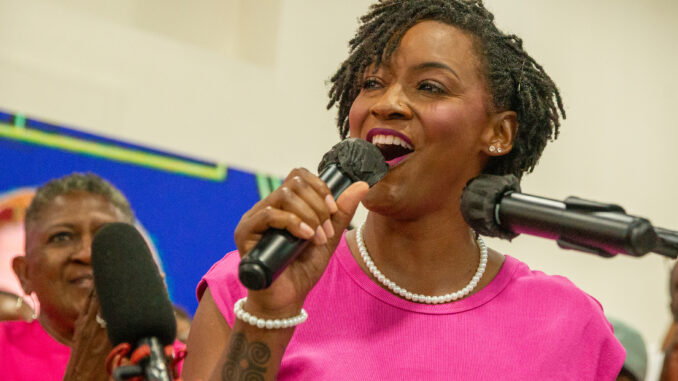
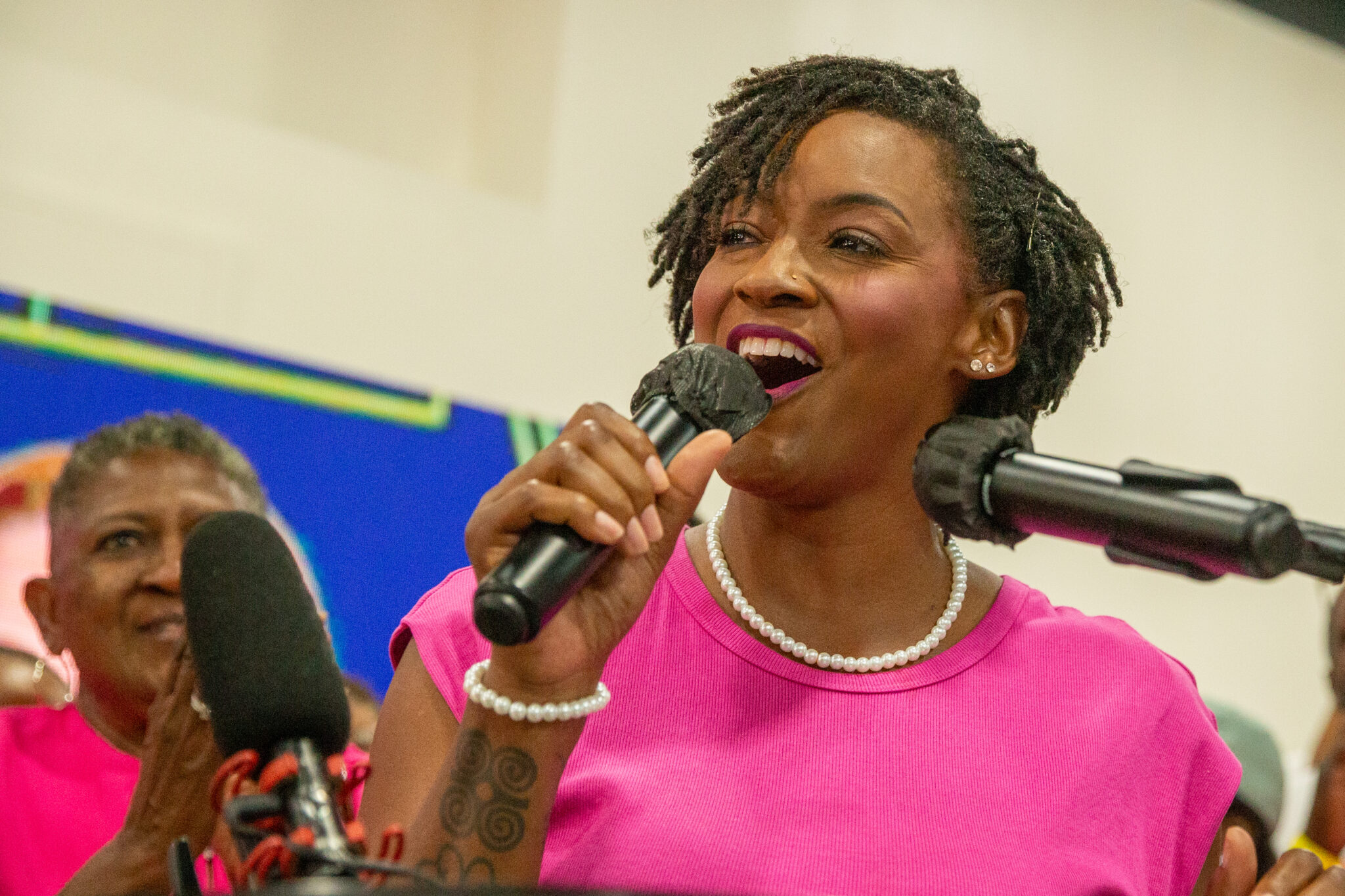
There is something about Angie Nixon.
Less than a week after the Jacksonville state representative stunned Florida’s political establishment by winning the Democratic nomination for U.S. Senate, Nixon’s name has moved far beyond Duval County and Tallahassee.
The Associated Press, The Washington Post, The New York Times, CBS News, Reuters, Axios and other national outlets have examined how a Black woman from Jacksonville with a fraction of her opponent’s campaign money defeated one of the most nationally recognizable Democrats in the race — and what her victory could mean for a Democratic Party searching for a path back to power.
Nixon defeated retired Army Lt. Col. Alex Vindman by roughly 12 percentage points in the Aug. 18 Democratic primary. Vindman was hardly an unknown candidate. His testimony during President Donald Trump’s first impeachment made him a national political figure, and Democratic donors poured money into his Senate campaign.
But money and name recognition did not translate into votes.
Vindman raised more than $16 million while Nixon raised less than $1 million. Nixon nevertheless won 49 of Florida’s 67 counties and captured about 56% of the statewide Democratic vote. In Duval County, where she was born, raised and built her political career, Nixon received about 80% of the vote.
That disparity is largely why the word “upset” has followed Nixon into nearly every national headline.
But it may also say something about what political observers were measuring — and what they missed.
Why was everyone so surprised?
Vindman had the money, national fundraising network and a résumé that made him familiar to Democratic donors across the country. He was widely viewed as the candidate already preparing to take on Republican Sen. Ashley Moody in November.
Nixon had something harder to quantify: grassroots relationships.
A former union organizer, longtime community activist and state lawmaker, Nixon spent years organizing in Florida before running statewide. Her Senate campaign traveled throughout the state, including communities statewide candidates often overlook. Her campaign relied heavily on grassroots organizing and social media rather than expensive television advertising.
Vindman, meanwhile, largely treated Nixon as a secondary concern. He declined to debate her and spent much of the primary focused on the anticipated general election. Nixon kept campaigning against him.
The results exposed the danger of equating fundraising with voter enthusiasm.
The Washington Post found Nixon performed especially well in counties with larger Black populations and in some of Florida’s lowest-income and least-college-educated communities. She won counties and constituencies that did not fit the conventional profile of voters expected to power a progressive insurgency.
In other words, the race may have been an upset nationally because Nixon was underestimated nationally.
In Jacksonville, the surprise was considerably smaller.
Nixon has been organizing and campaigning for years. She entered the Florida House in 2020 after defeating an incumbent Democrat and became one of the Legislature’s most visible opponents of Republican policies, particularly on redistricting, education and economic issues.
She also has never lost an election. Take note.
Why the “Democratic socialist” label?
Perhaps no description has followed Nixon more closely since election night than “democratic socialist.”
There is a factual reason: Nixon joined the Democratic Socialists of America during the campaign.
But the label does not tell the entire story.
Nixon joined DSA only recently, and the organization did not endorse her Senate campaign. Axios reported that some DSA activists had questioned whether Nixon was sufficiently socialist before she joined, and the organization itself did not anticipate her victory.
Nixon also rejects attempts to make the label the definition of her candidacy.
“It’s not necessarily a socialist message or a progressive message,” Nixon told CBS News after her victory. “It’s actually just about the needs of people.”
She has also described herself as a capitalist who believes in strong regulation. Her platform, however, includes policies associated with the progressive wing of the Democratic Party, including Medicare for All, canceling medical debt, expanded childcare and paid family leave.
That distinction could become critical in November.
Republicans have spent years making “socialism” a potent political attack in Florida, particularly in South Florida communities with large Cuban, Venezuelan, Colombian and Nicaraguan populations whose families have experiences with socialist and authoritarian governments. Moody and Republicans wasted little time highlighting Nixon’s DSA affiliation after the primary.
For Nixon, the challenge will be persuading voters to evaluate her policies rather than the label Republicans attach to them which they already have.
A historic possibility
The election also carries a piece of history that extends beyond party politics.
Florida has never elected a Black person to the United States Senate.
The U.S. Senate’s historical record lists 12 Black senators since Hiram Revels of Mississippi became the first in 1870. None represented Florida.
A Nixon victory would therefore make her Florida’s first Black U.S. senator.
It would also be extraordinary politically.
Florida has shifted sharply Republican in recent elections. Republicans hold a voter-registration advantage of roughly 1.5 million, and Trump carried Florida by 13 percentage points in 2024. Moody enters the general election as the favorite.
Democrats need a net gain of four seats nationally to capture control of the 100-member Senate, according to Reuters. Florida was already considered a difficult pickup before Nixon became the nominee.
That makes the race important to Democrats for reasons beyond whether Florida appears on anyone’s list of easiest Senate seats to flip.
If Nixon can make Florida competitive, Democrats would force Republicans to defend money and resources in a state they have increasingly treated as safely red. If her grassroots strategy increases turnout among Black voters, younger voters, working-class Floridians and Democrats who have become disengaged from the party, her campaign could also affect races farther down the ballot.
And if she wins, Democrats would not simply gain a Senate seat. They would have evidence that the conventional wisdom about how to compete in Florida needs to be reconsidered.
If she loses decisively, moderates are almost certain to argue that nominating a candidate Republicans can characterize as socialist made an already difficult state even harder to win.
That is part of why Nixon has suddenly become a national political test case and all eyes are on her already attracted heavyweight attention.
Sen. Bernie Sanders of Vermont endorsed her two days after the primary, calling her victory evidence that organized voters can defeat wealthy and powerful interests. The endorsement has particular resonance because Nixon worked on Sanders’ 2016 presidential campaign as an African American outreach deputy field director.
Her existing supporters include U.S. Reps. Maxwell Frost, Ilhan Omar, Rashida Tlaib and Ayanna Pressley, along with a substantial roster of Florida elected officials.
Sen. Elizabeth Warren has delivered her vote of confidence to Nixon and has publicly called for Democrats to unite behind all of the party’s Senate nominees and invest resources in them.
More national endorsements are likely as Democrats decide whether Nixon’s unexpected nomination represents an opportunity worth investing in.
The early financial response suggests her victory generated enthusiasm. Nixon’s campaign reported raising $1 million in the first 48 hours after the primary, more than it raised during the entire primary campaign and said about 40,000 people had signed up to volunteer. Clearly, Florida is excited.
Something about Angie
For years, Florida Democrats have searched for the formula that might reverse their decline in a state they once regularly won.
Nixon is offering a decidedly different experiment.
She is not running away from her record as an activist. She is not presenting herself as a carefully constructed statewide candidate. And she did not wait for Florida’s Democratic establishment or national donors to decide she was viable before behaving as though she was.
She traveled the state, talked about health care, wages, housing and the cost of living, and asked voters who often feel ignored to believe they had enough collective power to overcome a multimillion-dollar campaign. She posted videos appealing to millenials and a forgotten electorate revealing she is one of theirs and was willing to work for their support.
Then they did.
The harder test comes in November against Moody, in an electorate dramatically less favorable to Nixon than the Democratic primary electorate.
But dismissing her chances solely because conventional political calculations say she should lose carries an obvious irony.
Those calculations said she should have lost already.
Perhaps that explains why a Jacksonville lawmaker who entered the primary as an underfunded candidate is suddenly being analyzed from Washington to New York and beyond.
There is something about Angie… and for the next several months, Florida may find out whether that something can make history.