
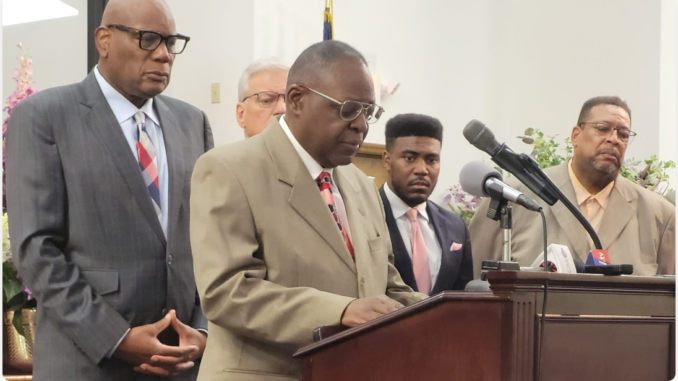
By St. Clair Murraine | Outlook Staff Writer | Calling Haitians “part of the American story,” Rev. RB Holmes led a group of local clergy members in a protest of a recent Supreme Court decision that could send thousands back to the county in the Caribbean.
The June 25 ruling by the Supreme Court could lead to Haitians and Syrians losing Temporary Protective Status, which allows them to live and work in the United States. Speaking at an afternoon press conference on July 8, Holmes said deportation of Haitians with TPS status could have a profound impact on the state.
Haiti’s infrastructure has been in shambles since gangs took over the capital city in 2021 assassinating President Jovenel Moïse in the process.
“Sending families into those conditions is not simply a political decision; it is a moral decision,” Holmes said. “When we extend compassion to those who live among us, work beside us, worship with us and strengthen our communities we honor our nation in its greatest moment. May it never be said that we saw suffering and remain silent.”
Holmes and other members of the group of ministers called for state lawmakers in Congress to act on behalf of the Haitian community. Holmes specially sent a letter to Sens. Rick Scott and Ashley Moody, asking them to take a lead in finding a resolve.
“As a pastor, I cannot remain silent,” Holmes said. “My faith will not allow it and my conscience will not permit it.”
Members of the media were given a handout stating ways to support the local Haitian community. They included appealing to elected officials, holding worship and prayer service on Aug. 16 and encouraging civic participation.
“Today we answer the clarion call to stand against (and) speak against racism,” said Tom Holcroft, pastor at St. Stephen Lutheran Church. “This potential human tragedy of sending Temporary Protected Status migrant people back to a war-torn and unsafe country is similar to sending people to death camps.”
Since the 6-3 Supreme Court Ruling on June 25, it has been unclear when TPS work permits would be revoked. The latest deadline put out by the U.S. Citizenship and Immigration Services is July 24 when work authorization is expected to expire for Haitian nationals.
Haitians have been allowed to come to the U.S. under TPS status since a 2010 earthquake devastated the island. The island has since since been a state of flux with gangs taking over most of the country.
Brant Copeland, retired First Presbyterian minister, called the Trump administration “cruel” for taking the TPS case to the Supreme Court.
“Lawlessness is one thing, but there are some things that are lawful that are not just,” Copeland said. “Even though it may be that the Supreme Court has given permission to expel Haitian refugees to their country, which has experienced terrible travails; even though that may be lawful it is not just. Justice without compassion is not justice at all.”
The court’s ruling has sparked protest around the country led mostly by the healthcare and hospitality industries.
In Florida, state data shows that 113,000 Haitian workers could be affected.
“They came seeking a better life,” said Joseph Wright, pastor at Jerusalem Missionary Baptist Church. “They should be allowed to seek asylum in the United States of America.”
Initially former DHS Secretary Kristi Noem wanted to terminate TPS for nearly 350,000 Haitians and more than 6,000 Syrians in early 2025. The two countries hold “Level 4” advisories from the U.S. State Department because of upheaval that prompted the US government to warn Americans not to travel to those countries.
However, despite that Noem had said neither country met the standard for fleeing natives to be granted asylum.
That eventually led to the case that the Supreme Court ruled on.
Many of the protest around the country are over the impact that deportation of Haitians on TPS would have on quality of life. The economic impact of Haitians having to lose job will also be devastating in their country. According to the Bank of the Republic of Haiti, Haitians in the United States sends approximately $3 billion in remittance home to Haiti annually.
“They contribute,” Holmes said. “They are not on welfare. It will be insensitive and inhumane to send them back to a country that is in a civil war.”
Noting that unrest has been part of Haiti’s existence for more than 200 year, Wright called for establishing a coalition to restore normalcy to Haiti. Discussion through an alliance, he said, could bring some “harmony and peace back to that country.”
Originating article below: