
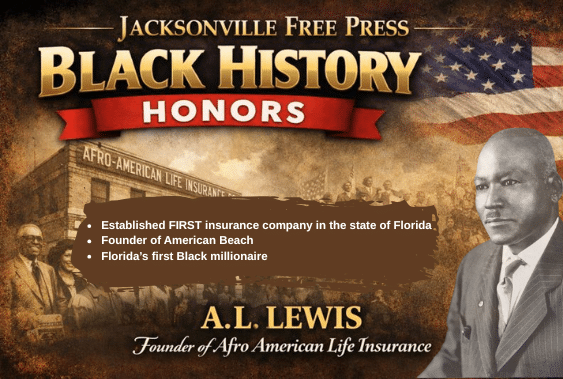
Long before the phrase “Black economic empowerment” entered modern political debates, Abraham Lincoln Lewis was quietly building the infrastructure of freedom in Florida.
Born in 1865 to parents who had been enslaved, Lewis rose to become one of the most influential Black businessmen and civil rights leaders in the early 20th century, helping to shape Jacksonville into a national hub of Black enterprise while laying groundwork for generations of community self-determination.
Lewis served as president of the Afro-American Life Insurance Co., one of the largest Black-owned insurance companies in the South during the Jim Crow era. At a time when Black families were routinely denied fair access to financial services, the company provided insurance coverage, jobs and a pathway to economic stability in communities excluded from white-owned institutions.
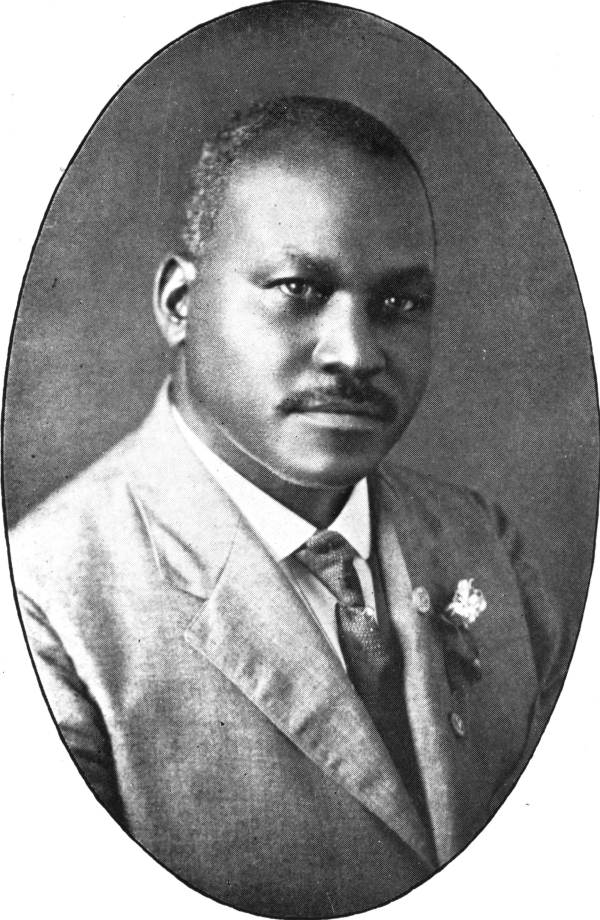
“Lewis understood that civil rights without economic power was incomplete,” said Dr. Tracy J. Revels, a historian of Florida’s Black communities. “He was building systems that allowed Black families to protect their wealth and invest in their futures when the broader society would not.”
Beyond insurance, Lewis invested in banks, newspapers and other Black-owned enterprises, helping to create a network of institutions that circulated money within Black neighborhoods. Jacksonville, often called the “Harlem of the South” during the early 1900s, became a center of Black business and culture in part because of leaders like Lewis.
One of Lewis’ most enduring legacies lies just north of Jacksonville, on Amelia Island. In 1935, he helped establish American Beach, a seaside community created as a refuge for Black families during segregation, when most Florida beaches barred African Americans.
Known as the “Negro Ocean Playground,” American Beach became a symbol of leisure and dignity in an era when Black joy itself was restricted. Families traveled from across the Southeast to vacation there, building memories and traditions that still resonate today.
Lewis also played a prominent role in the NAACP, serving as president of the Florida State Conference of NAACP branches. His leadership helped strengthen the organization’s reach across the state at a time when civil rights activism carried significant personal risk.
“A.L. Lewis represents a generation that fought on multiple fronts,” said Jacksonville civil rights attorney Daryl Parks. “He was challenging segregation through institutions, through land ownership, and through organized advocacy.”
Historians say Lewis’ legacy remains relevant amid contemporary debates over equity, funding and access to resources for Black-serving organizations. As public and private support for race-focused initiatives faces increased political scrutiny, Lewis’ life offers a reminder of how Black communities historically relied on self-built institutions to survive and thrive.
Today, organizations such as the A.L. Lewis Fund, housed at the Community Foundation for Northeast Florida, seek to honor that legacy by investing in local nonprofits focused on health, education and economic development in underserved communities.
For many in Jacksonville, Lewis is more than a historical figure. He is a blueprint.
“He showed what was possible even when the doors were closed,” Revels said. “That kind of vision is still what communities are drawing on today.”