
JACKSONVILLE, Fla. — Jacksonville pharmacist Albert Chester II returned to Jacksonville after attaining a degree from FAMU as a hometown hero. The son of a local football star, the newly minted doctor opened a much-needed pharmacy in the inner city on Moncrief Road. He also turned his passion for community into a congressional run. Unfortunately, it appears that passion was a segue into a fraudulent driven money scheme.
Chester is now among several defendants implicated in a sweeping $51 million federal health care fraud scheme that allegedly exploited vulnerable residents by using offers of free government-sponsored cellphones to obtain personal information and generate fraudulent prescriptions for expensive HIV medications.
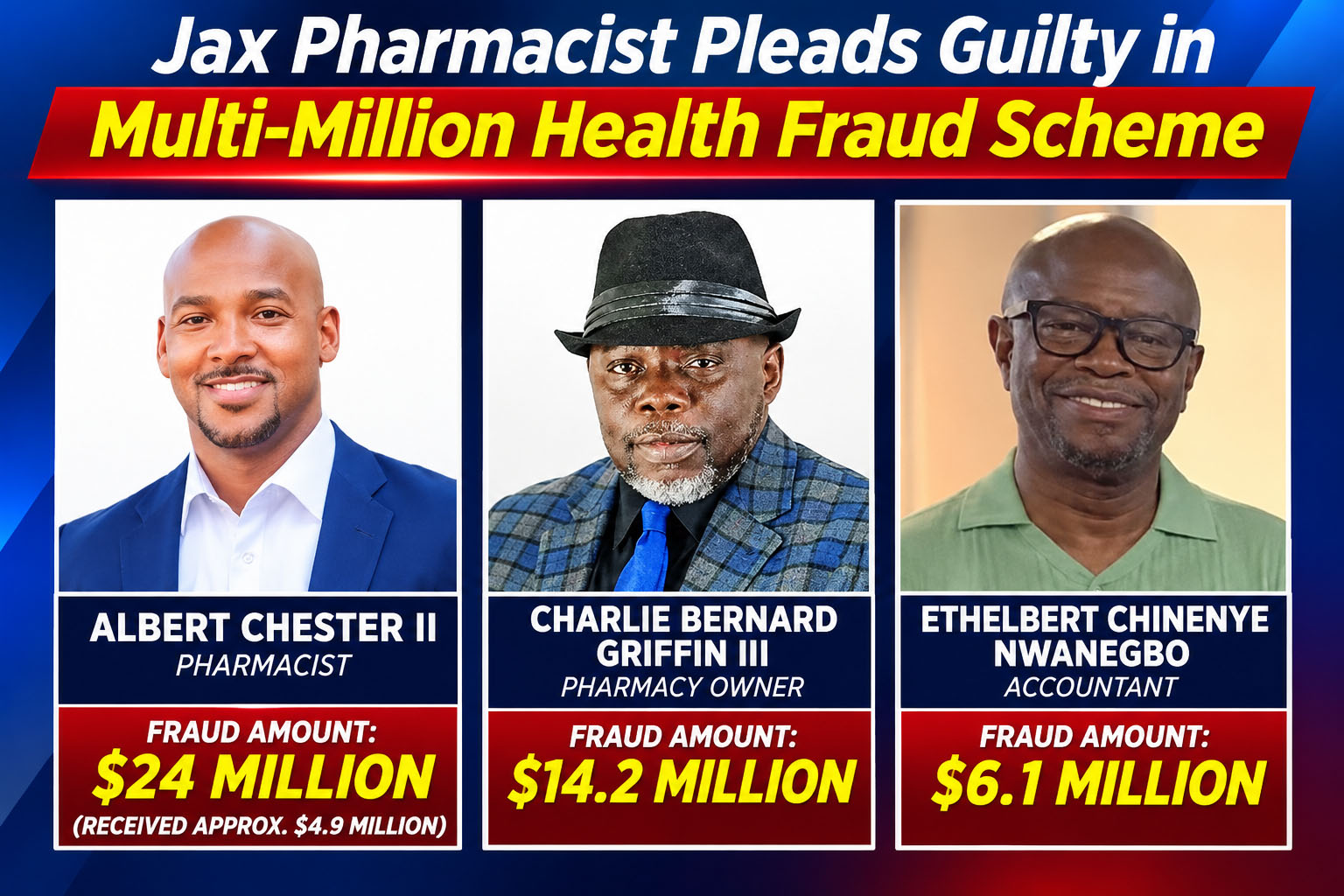
According to federal investigators, Chester, a pharmacist at First Coast Community Development (FCCD), was connected to more than $24 million in claims submitted to Medicare and Medicaid and received approximately $4.9 million in proceeds.
Chester was previously charged in a separate federal case and agreed to plead guilty, according to the U.S. Attorney’s Office.
The investigation centers on a Jacksonville pharmacy operated by FCCD, which was owned by Charlie Bernard Griffin III, 61. Griffin and accountant Ethelbert Chinenye Nwanegbo, 47, of St. Johns, were subsequently indicted on federal health care fraud and money laundering charges.
Federal prosecutors allege that Griffin partnered with a marketing company operated by Jonathan Gholston to recruit residents at community outreach events, including locations serving low-income and homeless populations.
Representatives set up tents and tables offering free government-sponsored cellphones. While collecting personal information, recruiters also obtained health insurance details, including Medicare, Medicaid and private insurance coverage.
That information was forwarded to FCCD and Chester, where prosecutors say it was used to generate prescriptions for costly HIV post-exposure medications.

The prescriptions were authorized by nurse practitioner Rashan Jones, who allegedly never examined, spoke with or evaluated the individuals receiving them.
According to the indictment, the pharmacy also submitted false diagnosis codes indicating patients had HIV, had been exposed to the virus or had a sexually transmitted disease. Those diagnoses were entered into medical records to obtain insurance reimbursement.
Federal investigators say there is no evidence the individuals needed the medications.
The operation allegedly relied on a system of illegal kickbacks. FCCD paid Gholston’s marketing company $200 for each referral that resulted in a paid insurance claim. Recruiters typically received $50 per successful referral.
Prosecutors say the operation generated tens of thousands of fraudulent claims, resulting in approximately $51 million in payments from Medicare, Medicaid and private insurers.
While Chester allegedly received $4.9 million, investigators say Griffin collected approximately $14.2 million.
Nwanegbo is accused of laundering proceeds through multiple bank accounts before returning the funds to Griffin and another participant, keeping approximately 10% as a fee.
Federal authorities are seeking forfeiture of millions in allegedly illicit proceeds, including more than $8.1 million seized from Griffin’s bank accounts, three properties and four vehicles.
Chester, Gholston and Jones were previously charged separately and agreed to plead guilty. Gholston was awaiting sentencing at the time of the reported proceedings.
The case has also raised concerns about the exploitation of Jacksonville’s most vulnerable residents, whose personal information was allegedly used without their knowledge to generate fraudulent insurance claims.
“They were basically victims of a fraud for which they had no benefit,” said Curtis Fallgatter, a former federal prosecutor not involved in the case. “Their name was used and they got nothing out of it.”
Fallgatter said targeting homeless individuals or other vulnerable populations could be considered an aggravating factor during federal sentencing.
The investigation is being conducted by the FBI, IRS Criminal Investigation and the U.S. Department of Health and Human Services Office of Inspector General. They said they were tipped off by concerned party which unfolded the events.
Griffin and Nwanegbo face substantial federal prison sentences if convicted. The maximum penalty for the charged offenses is 20 years per count.
Chester’s involvement highlights the central role investigators say the pharmacy played in converting personal information collected through community outreach into millions of dollars in fraudulent insurance reimbursements.
The charges against defendants who have not entered guilty pleas remain allegations, and those defendants are presumed innocent unless proven guilty.
Gholston, Chester and Jones