
As Black churches increasingly move beyond the pulpit into economic development, a small group of high-profile pastors—many tied to the prosperity gospel tradition—illustrate how faith, media, and business ventures have converged to build multimillion-dollar ministries and personal brands.
The shift comes as churches across the country are also embracing initiatives like “Spend in the Black,” a Chicago-based effort led by the Rev. Dr. Charlie E. Dates of Salem Baptist Church of Chicago and Progressive Baptist Church. The campaign encourages consumers to direct their dollars toward Black-owned businesses, framing spending as a tool for community empowerment.
“This is about resurrecting the Black dollar,” Dates said. “So rather than being in the red, we are spending in the Black.”
The initiative has drawn elected officials and business owners across the country and helped generate large vendor marketplaces featuring Black-owned businesses.
Against that backdrop, a number of prominent Black pastors have become symbols—both celebrated and scrutinized—of wealth accumulation within modern American Christianity. While pastors have these powerful roles of inspiration and engagement, where does that transcend to empowerment of those that listen to them or is it for entertainment purposes only?
Mega-ministries and media empires
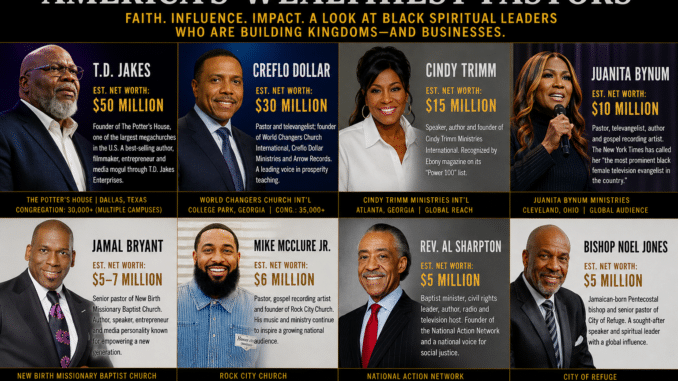
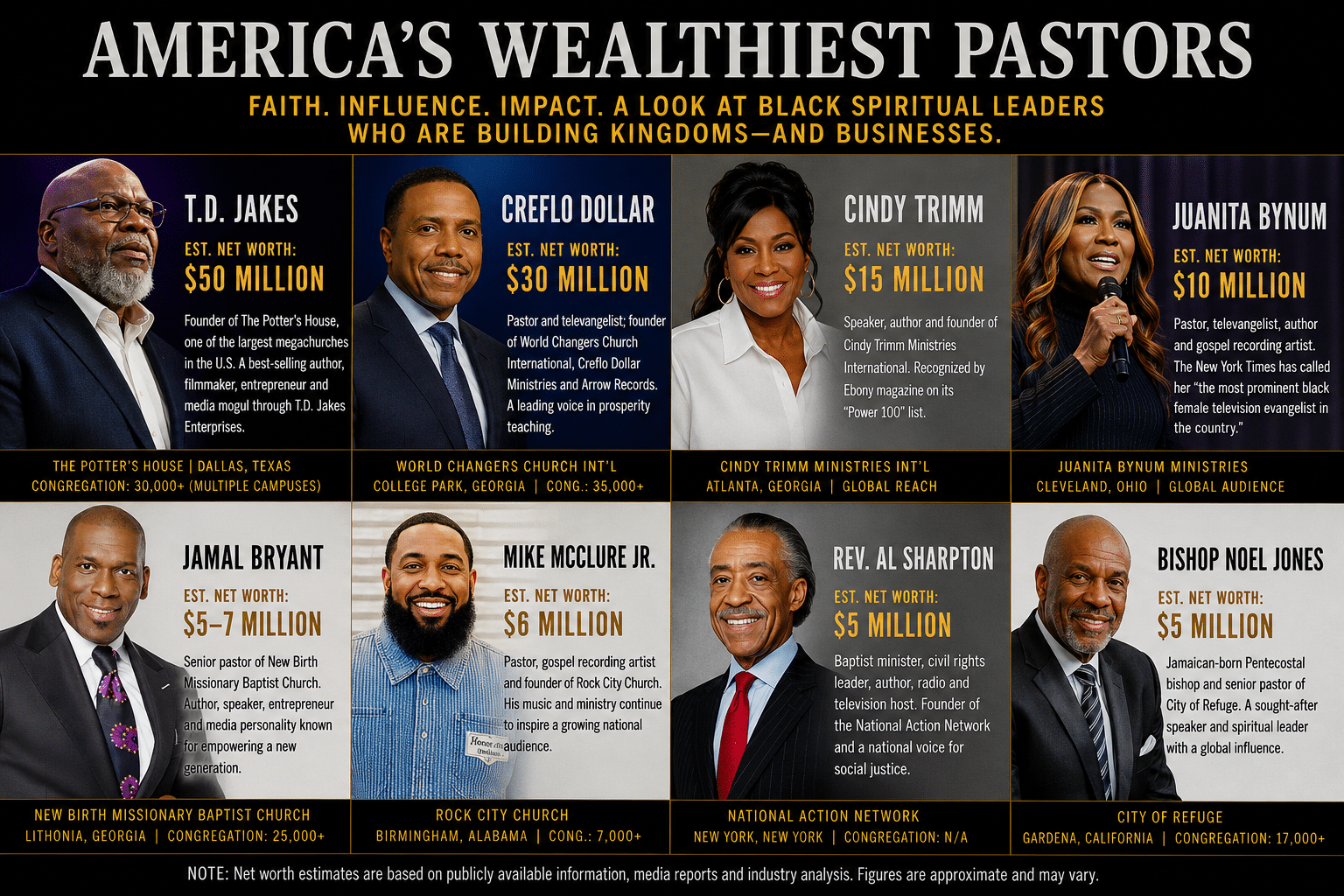
Among the most widely cited is T. D. Jakes, founder of The Potter’s House in Dallas, one of the nation’s largest megachurches. Jakes’ estimated net worth is commonly placed between $20 million and $50 million, driven not only by church leadership but also by book publishing, film production, conferences, and media ventures.
Another leading figure is Creflo Dollar, founder of World Changers Church International in Georgia. Dollar is closely associated with prosperity preaching and has built a global ministry empire that includes broadcasting, books, and organizational networks. His estimated net worth is widely reported in the tens of millions.
Prosperity theology—the belief that faith, giving, and positive confession can lead to material and physical blessing—has been a defining and controversial feature of several large ministries. Critics argue it risks conflating spiritual devotion with financial success, while supporters say it empowers congregants to pursue economic stability and generational wealth.
Advocacy, Authors, speakers and media ministries
Other prominent figures include Cindy Trimm, a speaker and author whose ministry and books have contributed to an estimated multimillion-dollar net worth, and Juanita Bynum, a televangelist and gospel artist whose public profile helped define early 2000s Christian media culture.
The Rev. Al Sharpton is one of the nation’s most recognizable civil rights activists, serving as founder and president of the National Action Network, which he established in 1991 to advocate for voting rights, criminal justice reform, economic opportunity and equal justice. An ordained Baptist minister, Sharpton does not serve as the senior pastor of a local congregation, instead focusing his ministry through NAN’s faith-based advocacy and weekly action rallies in Harlem. Over four decades, he has led or supported campaigns involving police accountability, voting rights, racial justice and economic equity, making him a prominent voice in national civil rights debates. He also represents a crossover between ministry, activism and media influence. Sharpton’s National Action Network, along with broadcasting and public speaking, contributes to an estimated multimillion-dollar financial profile.
Pastor Jamal Bryant of Atlanta has emerged as one of the nation’s leading voices for economic activism, urging Black consumers to use their collective buying power to influence corporate policies. Bryant gained national attention after launching a boycott of Target in 2025 following the retailer’s rollback of several diversity, equity and inclusion initiatives. Framing the campaign as both a faith-based movement and an economic protest, Bryant called on consumers to redirect spending to Black-owned businesses while demanding greater corporate investment in Black businesses, partnerships with historically Black colleges and universities, and continued commitments to economic inclusion. In March 2026, Bryant declared the yearlong boycott a partial victory, saying organizers had secured progress on three of their four major demands while pledging to continue monitoring corporate accountability.
Regional megachurch leadership
In Los Angeles, Bishop Noel Jones leads City of Refuge, a congregation often cited at nearly 17,000 members. Like many megachurch leaders, his income is tied to pastoral leadership, speaking engagements and media visibility.
Younger leaders are also emerging in the same space. In Birmingham, Alabama, Mike McClure Jr.—also known as Pastor Mike Jr.—has built Rock City Church alongside a growing gospel music career. His income streams include church leadership, recording success and speaking engagements.
Faith, economics and community reinvestment
The visibility of wealth among some pastors has fueled ongoing debate about prosperity preaching, particularly in Black church traditions where churches have historically served as centers for civil rights organizing, education and mutual aid.
At the same time, initiatives like “Spend in the Black” highlight a renewed focus on collective economic strategy. Supporters say Black churches are uniquely positioned to mobilize consumers, build business networks and circulate dollars within underserved communities.
The U.S. Black consumer market now represents hundreds of billions of dollars in annual spending power, according to industry estimates, giving faith-based economic initiatives new urgency.
Organizers say the goal is not only spiritual uplift but material transformation.
“This is not a one-day event,” Dates said. “It’s about building sustainable ecosystems.”
Unfortunately, no matter how big the congregation, these pastors and their voices are rarely united. As Black churches continue to expand their role from spiritual leadership to economic advocacy, the intersection of faith, wealth and community investment remains a defining and evolving part of American religious life.