
The same seat, the same dishes, the same pause before anyone eats | By Jeric Macaraan
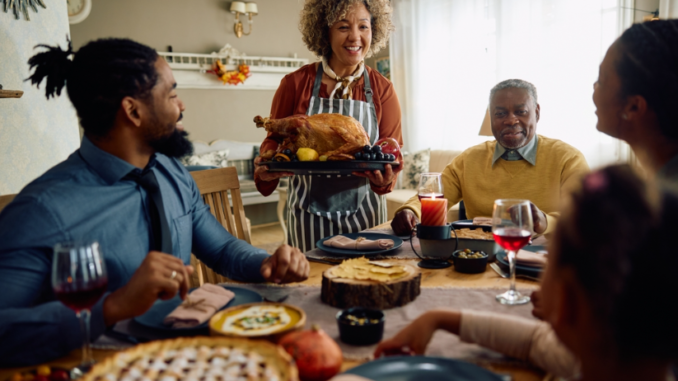
The turkey comes out last, carried by the same hands that have carried it out for years, and nobody rushes her. By the time she sets it down, the table is already full of voices, the kind of noise that only happens when three generations are in one room at the same time. This is what Thanksgiving looks like in a lot of Black households, and it rarely changes much from year to year, even as everything else around the family does.
The holiday has become less about the calendar date and more about the ritual itself, repeated so consistently that the repetition is the point. Outsiders might assume that kind of sameness gets boring after enough years, but inside these families it tends to work the opposite way, growing more meaningful each time it happens rather than less
The seat she holds at every Thanksgiving table
There is usually one chair at a Black Thanksgiving table that nobody else sits in, even if she never announced it as hers. It belongs to the person who has hosted the longest, who remembers who likes dark meat and who does not, and who notices if someone new is at the table before anyone else does. That seat carries more than habit. It carries decades of the same holiday repeated with slight variations, which is exactly what gives the day its weight. Younger relatives may not clock it consciously, but they understand the order of things the same way they understand which direction the pie goes around the table.
The dishes that never get swapped out
Every Black Thanksgiving table has at least one dish that is not up for debate, no matter how many cooking shows or food trends suggest an upgrade. It might be the mac and cheese, the candied yams, or a dressing recipe that exists nowhere in writing because it was never meant to be written down. Someone always offers to bring something different, and it is almost always politely declined. That refusal is not stubbornness. It is protection of a flavor that is tied to a specific person, a specific kitchen, and a specific stretch of family history that nobody wants diluted by convenience, Thanksgiving after Thanksgiving.

What saying grace really holds
Before anyone eats, there is usually a pause, whether it is a formal blessing or just a moment where someone says what they are grateful for out loud. In many Black families, that pause does more work than its length suggests. It is where names of people who are no longer at the table get spoken again. It is where a hard year gets acknowledged without turning into a speech. Thanksgiving becomes less about the meal in that moment and more about naming what the family has survived together, which is often the real reason the day carries so much emotional weight year after year.
Why younger family members keep coming back for Thanksgiving
Families today are more spread out than they used to be, with jobs and relationships pulling people to different cities and even different countries. That makes the pull toward one specific day and one specific table even stronger, not weaker. For a lot of younger relatives, Thanksgiving is the one holiday that reliably brings the whole family back under one roof, which means it carries pressure that other days do not. Missing a Thanksgiving gathering can feel like missing a piece of family history being retold, even if nobody says that directly, and that feeling tends to grow stronger with every year someone has to travel home for it.
Why the table resists change
None of this means Black families are against change elsewhere in their lives. It means the Thanksgiving table has become one of the few constants left, a place where the same seat, the same dishes and the same pause before eating all signal that something has survived. That consistency is not nostalgia for its own sake. It is a quiet form of resilience, passed down the same way a recipe is, without a formal lesson attached to it. As long as that table keeps getting set the same way every Thanksgiving, the history it carries keeps getting passed down with it, one holiday at a time, to whoever is lucky enough to be sitting there.
To read more:
https://rollingout.com/2026/11/24/black-thanksgiving-traditions-families/