
 Award-winning film brings prostate cancer awareness to Black communities and encourages men to have difficult conversations about their health
By Lynn Jones | A small gland about the size of a walnut can have an enormous impact on a man’s life.
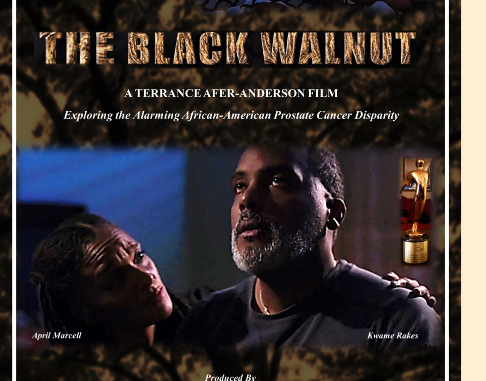
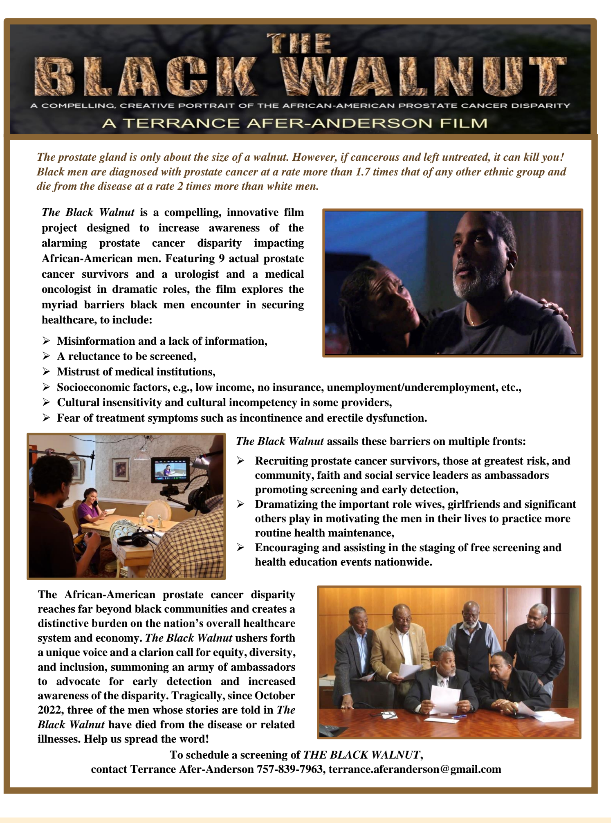
That is the message behind The Black Walnut, an award-winning 87-minute film that uses friendship, family and personal experience to shine a light on prostate cancer and the health disparities affecting African American men.
The film will premiere September 11 as part of a special prostate cancer awareness presentation.
At the center of the story is an African American man who seemingly has everything to live for — a loving wife, two children and a promising corporate career. But while he works to climb the corporate ladder, his health begins to deteriorate.
His wife, concerned about the changes she sees in her husband, privately encourages him to visit a doctor for a checkup.
That decision becomes a turning point.
After being diagnosed with prostate cancer, he begins treatment and ultimately gets an opportunity to continue living and telling his story. But the film deliberately leaves audiences questioning what might happen next.
During a preview, viewers encounter a funeral scene in which a man lies in a casket. For a moment, it appears the main character may have lost his battle with cancer.
He hasn’t.
Instead, the man in the casket is his childhood friend.
That scene captures one of the film’s central themes: prostate cancer does not have the same outcome for every man. Early detection and timely treatment can make a difference, while delays in seeking care can have devastating consequences.
Three friends, three different journeys
The Black Walnut follows three childhood friends whose lives remain connected even as each man confronts prostate cancer differently.
One struggles with the disease largely on his own. Another reaches treatment in time. Another does not survive.
Their stories are fictional, but the issues surrounding them are very real.
For writer, producer, director, actor, journalist and television host Terrance Afer-Anderson, the film is also deeply personal.
Afer-Anderson’s own prostate-health journey began in 2009 and returned again in 2023, when he underwent additional treatments.
Those experiences helped fuel his determination to address what he describes as significant health disparities.
“These are very important health disparities that we are facing,” Afer-Anderson said.
His personal experience also led him to examine some of the reasons men may delay medical care, including stress, cultural attitudes and simply not seeing a doctor soon enough. The PSA test is the routine test to determine if a male has it. Per the medical profession. ‘The Prostate-Specific Antigen (PSA) is a protein produced by the prostate gland. A PSA test is a routine blood test used to screen for prostate cancer or monitor other prostate conditions.’
Opening the Conversation
Afer-Anderson believes one of the film’s greatest accomplishments is that it creates a safe space for people to talk.
“The film created an atmosphere for men and women to talk,” he said.
Rather than simply presenting statistics or pointing fingers, the film explores culture, health-care experiences and the complicated relationship some African Americans have with medical institutions.
The legacy of the Tuskegee syphilis study, for example, is referenced as part of the historical context behind distrust of the medical system in some African American communities.
That distrust can have serious consequences when it causes people to delay seeking care.
“We have to advocate for adequate health care,” Afer-Anderson said.
More than Survival
The film also tackles subjects that can be difficult for men to discuss, including sexual and reproductive health.
Prostate cancer and its treatment can affect sexual function and quality of life, issues that Afer-Anderson says need to be part of the conversation rather than treated as subjects that should remain unspoken.
Early conversations with health-care professionals can help men understand their individual risk, screening options, potential treatments and possible side effects.
And, importantly, prostate cancer may not produce noticeable symptoms in its early stages.
That is why Afer-Anderson wants men to have informed discussions with their health-care providers about whether and when PSA testing and other prostate-cancer screening approaches are appropriate for them.
From Film Festivals to Community Health Fairs
The message of The Black Walnut has already extended beyond the movie screen.
The film received numeriuse film festival awards and is now being used at community health fairs and small-group table discussions to encourage conversations about prostate health.
For Afer-Anderson, those intimate settings are particularly important.
A movie can tell the story, but the conversation that follows may be where change begins.
He hopes the film will eventually reach an even larger national audience, including through a potential TED Talk.
For now, the September 11 premiere offers another opportunity to bring an important health issue into the spotlight.
The film’s message is ultimately simple: Men should not wait until something feels wrong to start thinking about their prostate health.
A conversation with a health-care professional, understanding one’s personal risk and making informed decisions about PSA testing and screening can be important steps toward protecting one’s future.
For Afer-Anderson, The Black Walnut is not simply a film about cancer.
It is a story about fathers, husbands, friends and families — and about making sure that a diagnosis does not have to be the final chapter.
“The Black Walnut” premieres September 11, 5- 8 p.m. as part of a special prostate cancer awareness presentation and parnrship with Mayo Clinic’s Cancer Health Equity Research Program (CHERP) and iCCaRE Partnership Engagement Services. The evening will also feature a free PSA screening in partnership with Agape Health. The event is hosted by Dr. Floyd Willis
The premier includes networking and refreshments beginning at 5:30 PM, and the film premiere at 6:00 PM, followed by a community discussion, inside WJCT Studios. Admission is free, and all are welcome. For more info contact Natee Fludd at fludd.natee@mayo.edu.