
With Florida’s Aug. 18 primary just weeks away, campaign fundraising is emerging as one of the clearest indicators of momentum in the race to succeed term-limited Gov. Ron DeSantis. The latest round of state matching funds shows Republican Byron Donalds and Democrat David Jolly widening their financial advantage over the field.
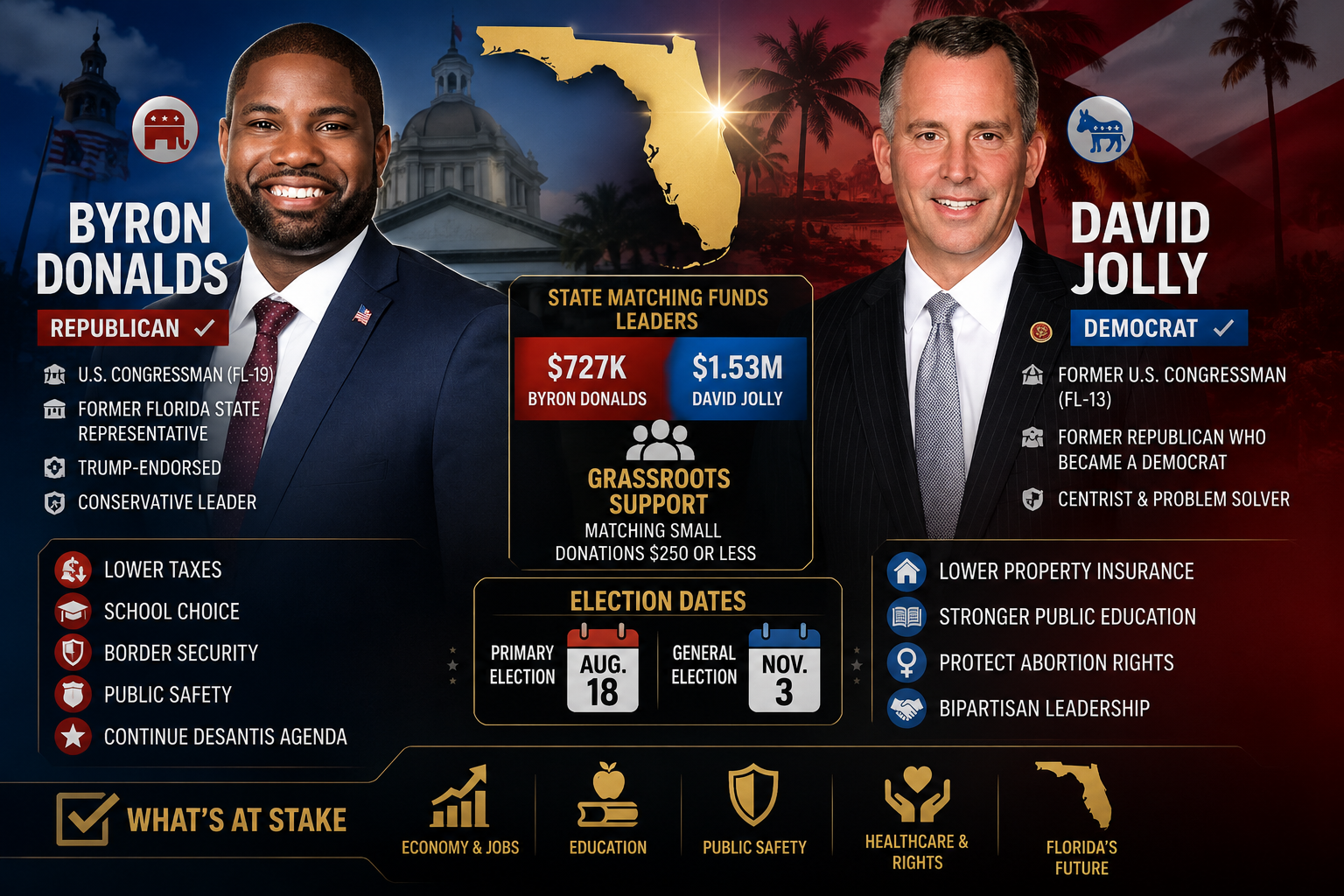
Jolly, a former Republican congressman from the Tampa Bay area who later became a Democrat, received another $229,000 in taxpayer-funded matching dollars Friday, bringing his total to $1.53 million—the largest amount awarded to any candidate. Donalds, a conservative Southwest Florida congressman and former state representative backed by President Donald Trump, added $65,600, increasing his total to $727,900. The state has distributed $2.8 million in matching funds over the past two weeks, with candidates qualifying by raising small-dollar donations from Florida residents.
The funding reflects more than campaign cash—it signals grassroots support because the state matches donations of $250 or less from Florida contributors after candidates meet qualifying fundraising thresholds.
Donalds has campaigned on continuing many of Gov. DeSantis’ conservative policies, including lower taxes, school choice, border security and public safety. Jolly has positioned himself as a centrist focused on lowering property insurance costs, strengthening public education, protecting abortion rights and bringing bipartisan leadership back to Tallahassee.
The Florida primary election is Aug. 18, followed by the general election on Nov. 3. Turnout could play a decisive role. Florida’s last two gubernatorial general elections drew 63% voter turnout in 2018, when Ron DeSantis narrowly defeated Andrew Gillum, and 54% turnout in 2022, when DeSantis won reelection by nearly 20 percentage points over Charlie Crist. Florida’s voter turnout is much higher for Presidential races averaging over 75%.
At stake is control of the governor’s office and the direction of the nation’s third-largest state on issues including the economy, education, insurance, immigration and public safety for the next four years.