
 by Sylvia Perry
More than a century after Madam C.J. Walker shattered economic barriers by becoming America’s first self-made female millionaire, a new generation of Black wealth creators is redefining what financial success looks like on a global scale.
Walker, who built a hair care empire for Black women beginning in the early 1900s, was recognized as America’s first African-American millionaire by 1910, just four years after founding her company. At a time when both racism and sexism severely limited opportunities for African Americans, Walker created a national sales network that employed thousands of Black women, giving them financial independence decades before such opportunities were commonplace. Beyond business, she became one of the nation’s leading philanthropists, supporting Black schools, churches, civil rights organizations and the NAACP’s anti-lynching efforts.
Today, Walker’s entrepreneurial spirit lives on through a growing class of Black billionaires whose businesses span technology, finance, sports, entertainment, media, manufacturing and private equity. Together, they represent tens of billions of dollars in wealth while employing hundreds of thousands of people worldwide, investing in underserved communities and inspiring future generations of entrepreneurs.
America’s first Black billionaire was Robert L. Johnson. Johnson achieved the milestone in 2001 after selling Black Entertainment Television (BET) to Viacom in a deal valued at approximately $3 billion. His ownership stake in the company netted him more than $1 billion, making him the first African American to appear on Forbes’ billionaire list.
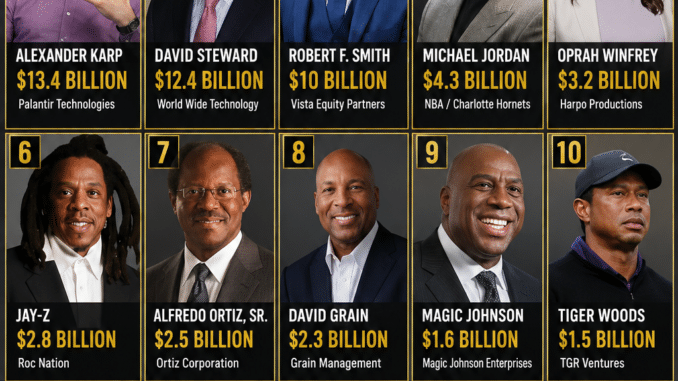
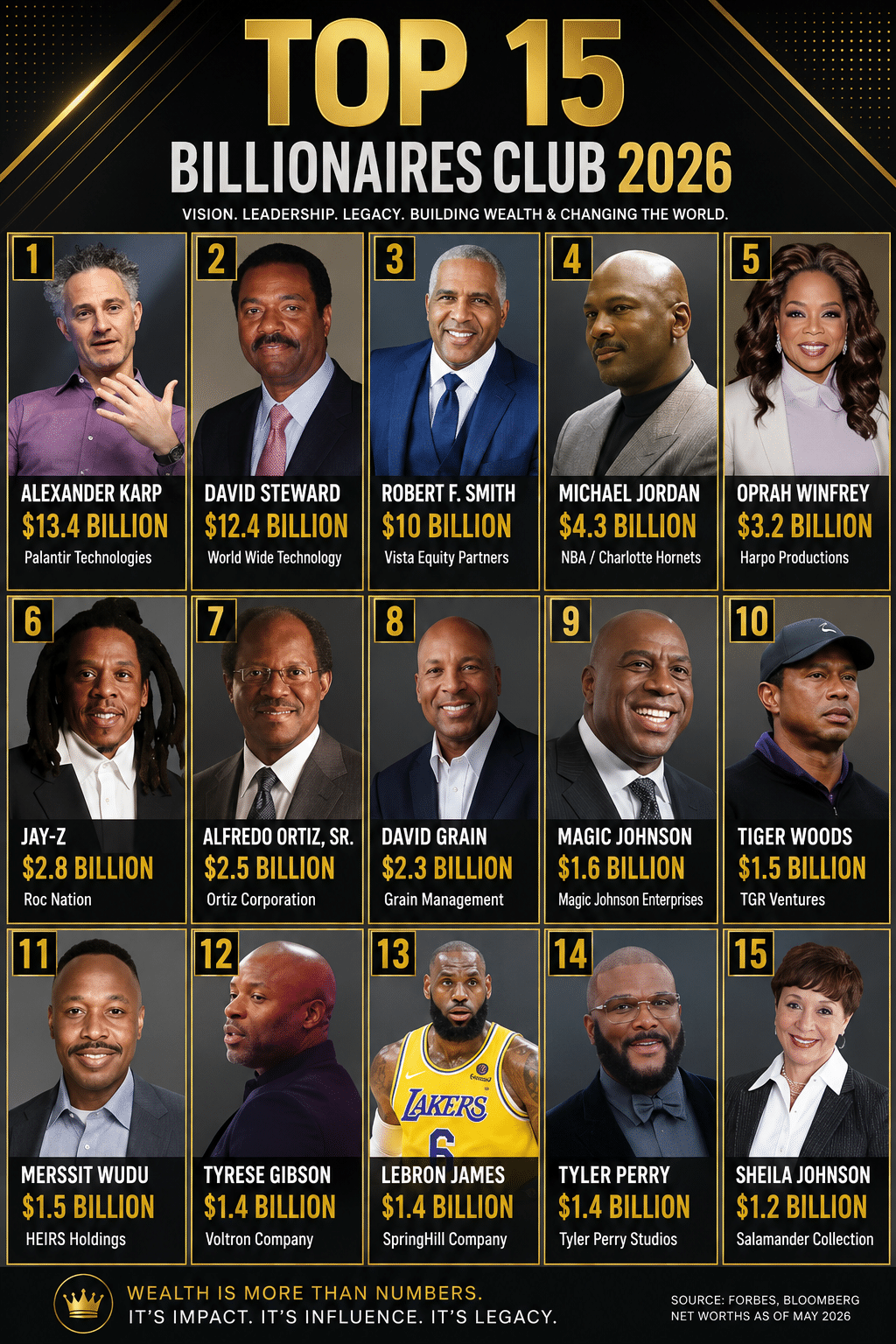
- Alexander Karp — $13.4 Billion: Alexander Karp tops the 2026 billionaire rankings through his leadership of Palantir Technologies, a software company specializing in artificial intelligence and big data analytics for governments and Fortune 500 companies. Under Karp’s leadership, Palantir has become one of America’s fastest-growing technology firms, employing thousands of engineers, software developers and cybersecurity professionals while advancing AI innovation worldwide.
- David Steward — $12.4 Billion: David Steward is one of America’s wealthiest Black businessmen and founder of World Wide Technology (WWT). Starting with just a handful of employees in 1990, Steward built WWT into a global technology integration powerhouse generating billions in annual revenue. The company employs more than 10,000 people worldwide and has become a model for minority entrepreneurship. Steward has also invested heavily in education, workforce development and faith-based initiatives, mentoring countless aspiring business leaders.
- Robert F. Smith — $10 Billion: Private equity investor Robert F. Smith transformed Vista Equity Partners into one of the world’s premier technology investment firms. Smith oversees investments in hundreds of software companies employing tens of thousands of workers globally. Beyond business, he became internationally known after paying off the student loan debt for Morehouse College’s Class of 2019. Through the Fund II Foundation, he has donated hundreds of millions of dollars to educational, health and racial equity initiatives while mentoring young entrepreneurs and investors. He is well noted for paying off an entire graduating class of Morehouse students.
- Michael Jordan — $4.3 Billion: Widely regarded as basketball’s greatest player, Michael Jordan turned athletic excellence into an unprecedented business empire. His partnership with Nike created the Jordan Brand, now generating billions annually. Jordan also profited through NBA ownership, endorsements and strategic investments. His companies support thousands of jobs in manufacturing, retail, marketing and sports management. Jordan has donated millions toward racial justice, education, disaster relief and health care while serving as an inspiration for athletes seeking ownership beyond the playing field.
- Oprah Winfrey — $3.2 Billion: Oprah Winfrey transformed herself from a local television anchor into one of the most influential media moguls in history. Through Harpo Productions, television networks, publishing and investments, she built an empire while creating opportunities for thousands of producers, journalists, writers and creatives. Winfrey’s philanthropic efforts include scholarships, educational initiatives and the Oprah Winfrey Leadership Academy for Girls in South Africa, impacting generations of young women around the world.
- Jay-Z — $2.8 Billion: Shawn “Jay-Z” Carter became the first hip-hop billionaire by building businesses far beyond music. His portfolio includes Roc Nation, entertainment management, luxury brands, investments, real estate and technology ventures. Roc Nation has launched and managed the careers of numerous artists, athletes and entertainers while employing professionals across music, sports, marketing and event production. Jay-Z has also advocated for criminal justice reform and economic empowerment in underserved communities.
- Adebayo Ogunlesi — $2.5 Billion: Adebayo Ogunlesi, a Nigerian-American financier, built his fortune as chairman and CEO of Global Infrastructure Partners before its multibillion-dollar acquisition by BlackRock. His firm invested in airports, ports, transportation systems and energy infrastructure around the world. Ogunlesi’s work supports tens of thousands of jobs globally while helping modernize essential infrastructure. He remains a role model for African professionals entering international finance and investment.
- David Grain — $2.3 Billion: David Grain founded Grain Management, one of the nation’s leading private investment firms specializing in communications infrastructure. His investments in broadband, wireless and digital connectivity have expanded technology access across America while supporting thousands of jobs. Grain is also recognized for mentoring minority entrepreneurs and increasing diversity within finance and private equity.
- Earvin “Magic” Johnson — $1.6 Billion: Magic Johnson successfully transitioned from NBA legend to one of America’s most accomplished businessmen. Through Magic Johnson Enterprises, he invested in movie theaters, restaurants, sports franchises, insurance companies and real estate projects, particularly in underserved urban communities often overlooked by major investors. His developments created jobs while revitalizing neighborhoods and demonstrating the economic potential of minority communities.
- Tiger Woods — $1.5 Billion: Tiger Woods became golf’s first billionaire through tournament earnings, endorsements, golf course design, hospitality ventures and business investments. His TGR Foundation has helped thousands of students pursue careers in science, technology, engineering and mathematics while opening doors for greater diversity in golf and business.
- Herriot Tabuteau — $1.5 Billion: Dr. Herriot Tabuteau built his fortune by founding Axsome Therapeutics, a biotechnology company focused on treatments for neurological and psychiatric disorders. His groundbreaking work has created high-paying scientific and medical jobs while advancing treatments that improve the lives of millions of patients. As one of the few Black billionaires in biotechnology, Tabuteau is helping diversify one of America’s most innovative industries.
- Tope Awotona — $1.4 Billion: Tope Awotona founded Calendly after investing his life savings into simplifying online scheduling. The software platform became one of the world’s most widely used productivity tools, serving millions of users and businesses globally. Calendly has created hundreds of technology jobs while demonstrating how immigrant entrepreneurs continue driving American innovation.
- LeBron James — $1.4 Billion: LeBron James became the first active NBA player to achieve billionaire status through basketball earnings, endorsements, SpringHill Company, media production, investments and ownership stakes. Beyond business, James founded the I PROMISE School in Akron, Ohio, and has invested millions in education, workforce development and community revitalization while creating opportunities for filmmakers, athletes and entrepreneurs.
- Tyler Perry — $1.4 Billion: Tyler Perry built one of the world’s largest independent film and television studios from the ground up. Tyler Perry Studios has become a major employer in Georgia’s entertainment industry, creating thousands of jobs for actors, directors, writers, production crews and technical professionals. Perry is equally known for his philanthropy, frequently assisting families facing hardship, supporting HBCUs and helping launch the careers of numerous Black actors and filmmakers. “I have made more Black millionaires—hear me when I say this—than any studio in this city combined because I’m making footprints,” said Perry at the 2025 BET Awards.
- Sheila Johnson — $1.2 Billion: Sheila Johnson made history as the first Black female billionaire after co-founding Black Entertainment Television (BET). She later expanded into hospitality, professional sports ownership and luxury resorts through Salamander Collection. Johnson has consistently championed women-owned businesses, arts organizations and educational causes while creating employment opportunities in hospitality, tourism and media. Today, she is worth more than her ex husband Robert Johnson because she continued to grow her fortune after the BET sale, while he made several investments that produced smaller returns or reduced his net worth.
A Legacy Bigger Than Wealth
The rise of today’s billionaires reflects a remarkable transformation that began with Madam C.J. Walker’s vision more than a century ago. While their fortunes were built in different industries—from software and private equity to entertainment and professional sports—their influence extends far beyond personal wealth.
Collectively, these entrepreneurs have created hundreds of thousands of jobs, launched businesses, revitalized communities, funded scholarships, invested in historically Black colleges and universities, supported medical research and inspired millions to pursue entrepreneurship and ownership. Their success demonstrates a broader shift in the American economy, where Black excellence increasingly shapes industries once largely inaccessible to African Americans.
From Walker’s pioneering beauty empire in 1910 to today’s multibillion-dollar global enterprises, the story of Black wealth is ultimately one of resilience, innovation and opportunity. It is a reminder that true success is measured not only by dollars accumulated, but by lives changed, communities strengthened and doors opened for those who follow.