
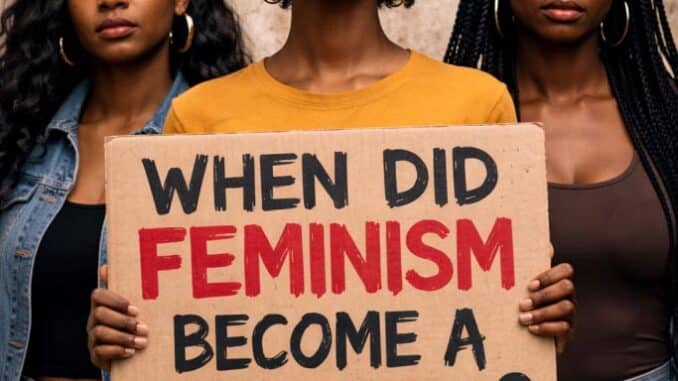

Feminism is not about hating men. It never was.
The word itself — rooted in the Latin femina, meaning woman — has carried, since its earliest recorded use in the 1890s, one foundational idea: That women deserve equal social, economic, and political standing with men.
So how did we get here? How did a word built on the scaffolding of basic human dignity become something people apologize for, distance themselves from, or hurl as an insult? The answer is not complicated, even if it is infuriating. The term was systematically dismantled. And nowhere is the cost of that dismantling felt more acutely, or more tragically, than in the Black community.
The description of a feminist has been twisted over the years. When I ask some men today what they think of the word, they describe it as brainwashed, angry, bitter women who hate men. These images are spread throughout podcasts, social media influencers, and unqualified internet personalities who have no basic understanding of this word.

When the late Kevin Samuels built an entire media empire on the premise that Black women who dared to have standards were broken and unworthy, he was not offering relationship advice. He was conducting a very public anti-feminist crusade, and millions tuned in. His audience was not made up of fringe extremists. They were our brothers, our uncles, our sons.
The recent rise of the so-called Passport Bros movement is another instructive example. Men who travel abroad in deliberate rejection of American women, citing their “feminism” as the disqualifying sin, are not reacting to feminism as it actually exists. They are reacting to a distortion of it. They have consumed so much misinformation about what the movement means that they have confused a woman’s assertion of her own worth with aggression against theirs.
This is not to say Black men hold a monopoly on this particular failure. There is a painful irony in women who actively work against their own liberation, who perform submission for social validation, who police other women’s ambitions, who dismiss gender inequality as exaggeration while benefiting daily from the rights that feminists bled to secure. The behavior is real, and it is a product of the same misinformation campaign that has made “feminist” a slur.
The tell is always the same phrasing: “I’m not a feminist, but,” followed by something Sojourner Truth, Ida B. Wells, or Shirley Chisholm would have said without hesitation. We have divorced the belief from the word so thoroughly that people are living feminist lives while treating the label like a communicable disease.
Black women have always been at the forefront of this country’s most consequential justice movements, frequently without recognition, frequently without protection, and frequently while being told to wait their turn. The phrase “who protects Black women?” did not emerge in a vacuum. It emerged because, too often, the answer has been not enough of us.
Feminism does not ask men to surrender their dignity. It asks them to extend the same presumption of humanity to the women in their lives that they demand for themselves. Both things can be true simultaneously. Black men can be oppressed by race and advantaged by gender. Acknowledging that complexity is intellectual honesty.
The word “feminist” does not need to be softened, renamed, or replaced. It needs to be reclaimed. Feminist is not a bad word. It is only treated that way by those who have been convinced that equality is a threat. It is not. The confusion about that is exactly where the real danger lives.