
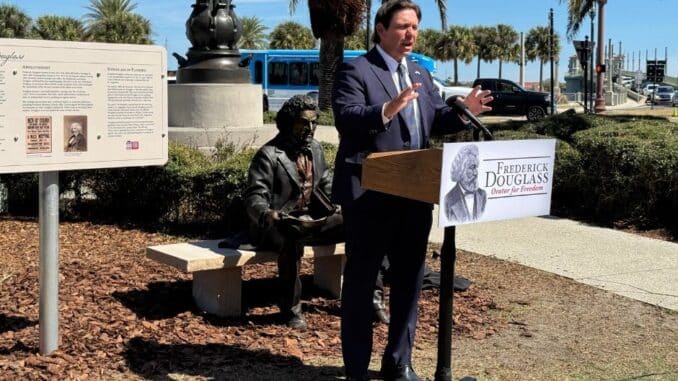
 ST. AUGUSTINE, Fla. — Florida Governor Ron DeSantis on Wednesday unveiled a new Frederick Douglass statue in Plaza de la Constitución, part of the state’s America 250 campaign marking the 250th anniversary of the United States. The bronze work stands near the location where Douglass spoke during his 1889 visit to the city — linking the abolitionist’s legacy to one of America’s oldest and most historically layered urban centers.
DeSantis, joined by state leaders, highlighted Douglass’s life: born into slavery, he taught himself to read and write, escaped bondage in 1838, and became a preeminent voice for abolition, equal rights and national unity. His autobiographical writings and decades of advocacy helped shape the struggle to bring the nation closer to its stated ideals of liberty and justice.
Douglass’s appearance in St. Augustine on April 7, 1889 came during a post-Reconstruction lecture tour. After drawing large crowds in Jacksonville, the famed orator arrived by train and addressed an audience at the Genovar Opera House on St. George Street. Some historical accounts record roughly 700 residents attending to hear him speak on the ongoing fight for African Americans’ civil and political rights — a reminder of his influence well after the Civil War.
St. Augustine’s significance in African American history extends far beyond Douglass’s visit with landmarks and sites including:
- Fort Mose Historic State Park: Located north of downtown, this site commemorates Gracia Real de Santa Teresa de Mose, established in 1738 as the first legally sanctioned free Black settlement in what would become the United States. Enslaved Africans who fled British colonies found asylum here under Spanish rule after pledging allegiance and converting to Catholicism. Fort Mose’s residents formed a militia that served as a key defense for Spanish Florida — making the community a foundational chapter in early Black freedom struggles.
- Florida Museum of Black History (planned): State law established a task force in 2023 to plan a Florida Museum of Black History, and St. Johns County — including St. Augustine — was recommended as its preferred location in 2024, positioning the city as a central hub for interpreting centuries of African American history in the region.
- Lincolnville and Civil Rights History: The Lincolnville Museum and Cultural Center — housed in St. Augustine’s first Black high school — preserves local Black heritage, including post-Civil War community development and direct links to the city’s role in the 1960s Civil Rights Movement. St. Augustine saw sit-ins, marches and activism that contributed to the passage of the Civil Rights Act of 1964.
By tying the Douglass statue to the Plaza and these broader heritage threads, state and local leaders say the installation not only honors an iconic national figure but also underscores St. Augustine’s deep and multilayered Black history — from colonial quests for freedom through Reconstruction and civil rights.