

 Author and philanthropist MacKenzie Scott has quietly reshaped the financial landscape of historically Black colleges and universities, giving more than $1 billion to HBCUs in just five years and redefining modern philanthropy in the process.
Scott, who signed the Giving Pledge in 2019 following her divorce from Amazon founder Jeff Bezos, has committed to giving away the majority of her wealth. Since then, she has distributed more than $26 billion to nonprofits, with a significant focus on education and racial equity. The Elizabeth City State $42 million donation is the latest chapter in Scott’s growing financial support of HBCUs, which began in 2020 and has accelerated over the past year. Since then, Scott has repeatedly made some of the largest private donations in the history of the schools she supports, often returning to institutions she had already funded.
A timeline of transformative giving
Scott’s support of HBCUs began in 2020, when she made an unprecedented $560 million in unrestricted donations to 23 institutions — many of them the largest single gifts in those schools’ histories.
She expanded that commitment in 2025, delivering another wave of more than $700 million to over a dozen HBCUs, along with major contributions to organizations such as the United Negro College Fund.
Her cumulative giving to HBCUs has now surpassed $1.1 billion to $1.3 billion, impacting more than 60 institutions nationwide.
Unlike traditional philanthropy, Scott’s gifts are largely unrestricted — allowing schools to decide how best to use the funds, whether for scholarships, infrastructure, faculty hiring or debt relief.
Closing historic funding gaps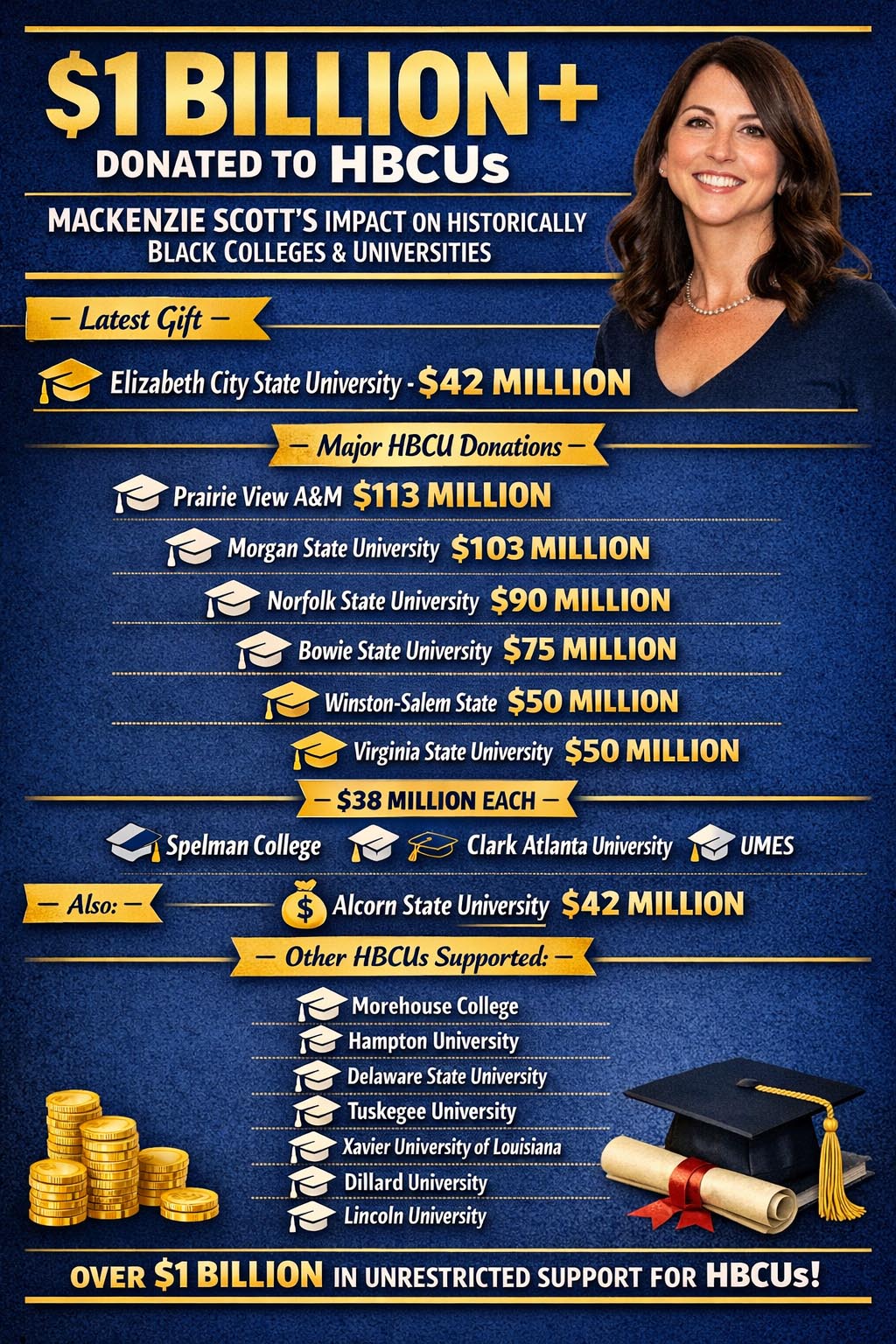
Scott’s giving comes against a backdrop of long-standing inequities. Studies show HBCUs have historically received a fraction of the funding given to predominantly white institutions, with Ivy League schools receiving dramatically higher levels of foundation support.
At the same time, overall philanthropic support for HBCUs declined in the early 2000s and 2010s, deepening financial disparities that continue to affect enrollment, facilities and research capacity.
Her donations — often described by university leaders as “transformational” — are helping to stabilize endowments, expand academic programs and increase student aid at a scale rarely seen in higher education philanthropy.
A philosophy rooted in trust and equity
Scott has said her giving is guided by a belief in empowering institutions rather than controlling them. Her no-strings-attached approach reflects a broader philosophy that those closest to the work are best positioned to decide how funds should be used.
That model stands in contrast to more traditional philanthropy, which often includes strict oversight and conditions. Her approach has been praised for treating HBCUs as “stewards of excellence,” rather than recipients of charity.
The investments come at a time when diversity, equity and inclusion initiatives are facing increasing political and corporate pushback across the country. Some companies and institutions have scaled back DEI programs, creating new funding gaps for organizations that support underserved communities.
For HBCUs — which have long played a central role in educating Black professionals and advancing social mobility — Scott’s contributions provide a critical counterbalance.
Her funding not only strengthens institutional stability but also signals confidence in the continued relevance of HBCUs at a time when broader support structures are under pressure.
University leaders say Scott’s gifts are more than financial — they are affirmations of value.
From expanding scholarship access to launching new research initiatives, her donations are helping HBCUs compete more equitably in higher education while preserving their historic mission.
As debates over equity funding continue nationwide, Scott’s philanthropy underscores a larger shift: one donor’s willingness to invest deeply, quickly and without conditions in institutions that have long been overlooked.
In doing so, she has not only changed the trajectory of dozens of HBCUs — but also set a new standard for what transformative giving can look like.