
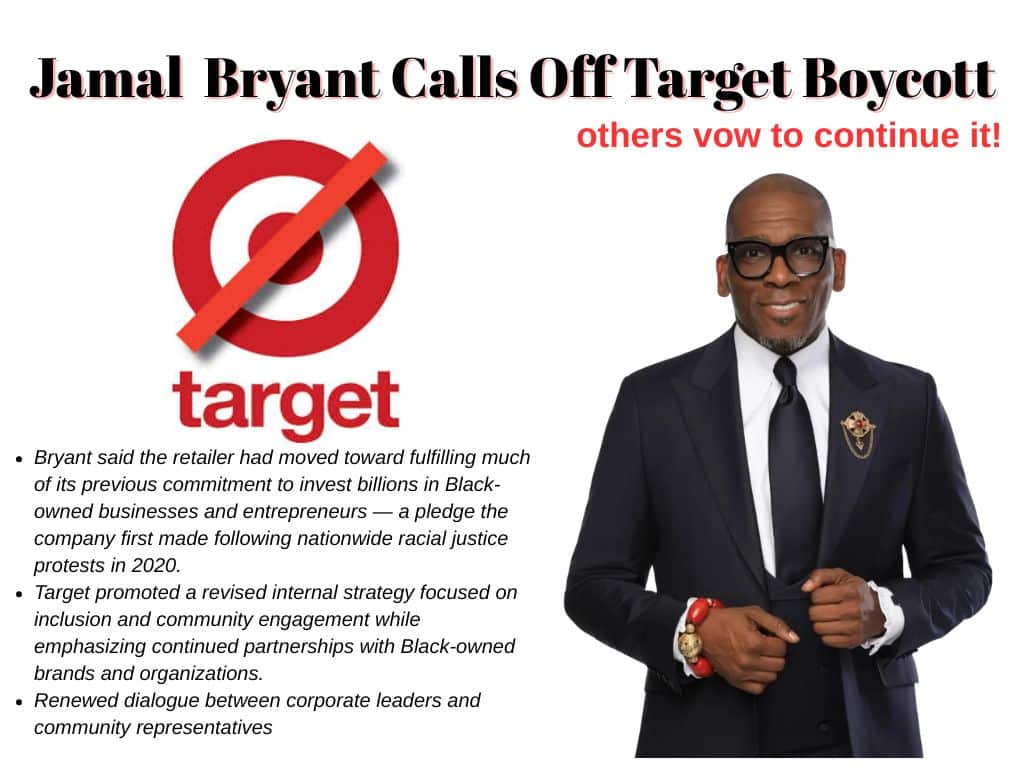
 The Rev. Jamal Bryant announced Wednesday that a nationwide boycott of Target he helped lead for the past year has come to an end, declaring the consumer protest a “victory” after the retail giant recommitted to some diversity and community investment initiatives that had been scaled back earlier.
Bryant, the senior pastor of New Birth Missionary Baptist Church in metro Atlanta, said the campaign demonstrated the economic power of Black consumers and faith-based organizing. The protest began as a 40-day “Target Fast” during the Christian season of Lent in March 2025 but quickly evolved into a national boycott as activists pressed the retailer over its retreat from diversity, equity and inclusion initiatives.
How the boycott began
The boycott grew out of backlash after Target announced in January 2025 that it would scale back or restructure several diversity programs and partnerships that had been expanded following the 2020 killing of George Floyd. Critics said the changes weakened commitments to support Black employees, entrepreneurs and community organizations.
In response, Bryant urged Black consumers to stop spending money at the retailer during Lent beginning March 5, 2025. The protest later expanded nationwide with church-led demonstrations, prayer gatherings and coordinated economic pressure campaigns aimed at forcing the company to honor earlier promises to invest in Black-owned businesses and institutions.
Impact during the yearlong protest
The boycott drew support from clergy, civil rights leaders and community organizations across the country. Organizers framed the movement as an exercise in “economic protest,” arguing that the buying power of Black Americans — estimated at about $2 trillion annually — could influence corporate behavior.
Retail analysts and activists alike noted measurable effects on the company. Target experienced declines in foot traffic and sales during portions of 2025, while the company’s market value dropped by billions of dollars during the period, according to reports analyzing the boycott’s economic impact.
Bryant and supporters described the campaign as one of the most visible economic protests led by Black consumers in decades, drawing comparisons to historic consumer boycotts in the civil rights era.
However, the boycott also sparked debate within the Black business community. Some activists warned that reduced shopping at Target could hurt Black-owned brands that rely on the retailer’s shelf space and distribution.
What Target did
In announcing the end of the boycott, Bryant said the retailer had moved toward fulfilling much of its previous commitment to invest billions in Black-owned businesses and entrepreneurs — a pledge the company first made following nationwide racial justice protests in 2020.
Target also promoted a revised internal strategy focused on inclusion and community engagement while emphasizing continued partnerships with Black-owned brands and organizations.
Bryant said those steps, combined with renewed dialogue between corporate leaders and community representatives, helped lead organizers to conclude the protest.
What comes next
While Bryant declared the boycott finished, some activists and local organizers say they plan to continue applying pressure on the company and other corporations over diversity commitments and economic equity.
Bryant framed the campaign as a broader lesson about the influence of collective consumer action.
“We are claiming victory,” he said in a broadcast announcing the decision. “Things may not be perfect, but they are better.”
He added that the protest showed corporations must take seriously the expectations of communities whose spending power helps drive the U.S. economy.