
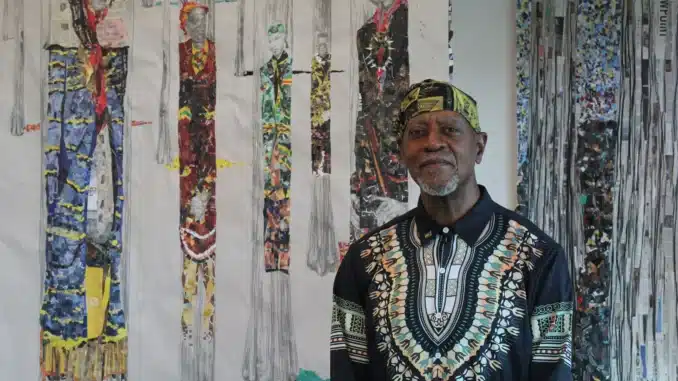
Charles Humes Jr. has spent a lifetime painting people. After two residencies in the Everglades, his subject matter hasn’t shifted, so much as expanded.
“I just needed a change,” Humes Jr. said. “Sometimes, you’re stuck in a rut where you’re working on one thing over and over again, and you don’t have a renewed vision about what you’re doing. You don’t have that emphasis, that energy, and you get a little stuck.”
Humes Jr., based in Miami, has been an artist for more than 40 years. His work spans the gamut of mediums, but has always been dedicated, he said, to telling the stories of “the lives, times, trials and genre of people of color.” Over the past two years, Humes Jr. has twice been selected for the Artists in Residence in Everglades (AIRIE) program, which allows its fellows to spend a month embedded in the river of grass, free from all distraction.
With both of his residencies now complete, the body of work Humes Jr. produced is on display for all to see, free of charge, in the AIRIE Nest Gallery, located in the Ernest F. Coe Visitor Center at Everglades National Park. The exhibition, “Gatherings,” will run through Jan. 24, 2026.
“When they invited me back as an alum for my second residency, I wanted to do something different,” Humes Jr. said. “I wanted to not only show and create work about the Everglades and its beauty, but about the history about the Everglades. I learned things that I never knew. I learned things that connected to me as a Black person.”
Humes Jr. spent time hiking across floodplains and wading among massive cypress trees, using his first residency to turn what he saw into a series of watercolor paintings and charcoal sketches. While he still explored the environment during his time as alumnus, he found his attention pulled to the history of the wetlands, along with the State of Florida at large. Throughout his second stint in the park, Humes Jr. said he found himself thinking about those who’d walked the same paths long before him.
“You have a rich history that a lot of people don’t know about,” he said. “When I found this information out, I said, ‘Well, let me devote some of my interest and some of my goals towards presenting it.’ So, not only having the beauty of the Everglades, the swamps, the image of cypress trees, the birds. But also a tribute to the foundation of Florida, the history.”
His studies resulted in three large-scale, mixed-media pieces: part graphite, part collage.
“These are based on wet walks that I attended where you walk in the swamp and you see the cypress trees,” he said. “But if you look very closely, you see little clues. You see symbols of the maroons and the Gullah and the Seminoles — their dress, their culture, is all embedded in that. And if you look at the bottom, you see the colors of the different colonial powers that sought to control them and force them out.”
The past wasn’t the only place Humes Jr. found inspiration. Although they aren’t exhibited, he said he spent swaths of time outside the park, drawing portraits of the people that make up the farming communities just beyond the borders of the Everglades.
“As an artist, I think of myself as a humanist,” he said. “I create narratives about people and places, no matter where I go. I think that people are essential with nature. They work hand in hand. In my first residency, I went outside the Everglades, and I spent time with the communities that live around the Everglades, these migrant communities. I went to their parks when they had soccer games and their picnics. I hung out with them.”
Spending most of his time alone, out among nature, Humes Jr. found his focus pared down. With no distractions, he could cut straight to the heart of what he wanted to make — particularly the second time around, given his familiarity with the landscape.
“I felt, after a little more than a week, that I wasn’t a visitor anymore,” he said. “I felt like I was actually part of the Everglades. I think that contributed to my productivity in creating works, because I wanted to move from one piece to another piece.”
And although the context was different, Humes Jr. found himself making art with the same hallmarks as his prior pieces. They weren’t set against the familiar backdrop of the city, but Humes Jr.’s portraits and mixed-media depictions still demonstrated a profound interest in the human element.
“I like to deal with the human nature of people in their genre,” he said. “And I look at making art about nature the same way I look at painting or creating works about the human condition. I transfer it over to what’s going on in the Everglades, as well, and especially the wildlife. The wildlife here is just amazing.”
And indeed, there is no shortage of wildlife in Humes Jr.’s Everglades portfolio. Some of his favorite pieces, he said, are the two portraits of birds he created during his first residency — of an anhinga and a great white heron. Realistic depictions of the environment and its habitants are the bread and butter of Humes Jr.’s exhibition, and he’s not done depicting them, even if his time in the park is over.
“I like to think that any artist that devotes their artwork towards nature is a divine thing, and I’m lucky to be a part of that,” he said. “I wasn’t before.”
Come the end of January, Humes Jr. will wrap up another residency he’s been involved in since the fall of 2025, this time at the Deering Estate. He said his experience in the Everglades made him keen to continue producing work in the same vein.
“It’s had a very profound influence on what I would do, going forward,” he said. “What I focused on was just the human condition and my concentration, my practice. Now I have a more keen sense of direction and discovery, where I’m not going to make the emphasis just on people, but I’m going to also concentrate and focus on the environment. I think that’s very important.