
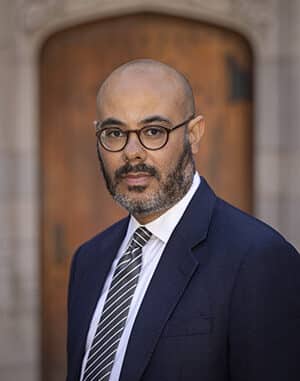
By Munson Steed |The Yale law professor and author discusses the Supreme Court’s decision on race-conscious admissions, its impact on Black enrollment, and pathways forward for universities seeking diversity. Professor Justin Driver has spent his career examining the intersection of constitutional law, education and racial equality. As a Yale Law School professor and author of The Fall of Affirmative Action, he anticipated the Supreme Court’s 2023 decision that would reshape university admissions across America.
Where does education land for a newborn citizen in this society when we think about equality based on the Constitution?
Education has been at the heart of disputes about the Constitution, including with respect to racial equality. The most revered Supreme Court opinion throughout the nation’s history is Brown v. Board of Education, dealing with the invalidation of racially segregated schools. The fact that case arose in the educational context is an important part of its legacy. When you’re talking about education, you’re talking about potential and opportunity and inequality as well. What happens in our educational spheres gets people’s blood boiling and gets people quite excited.The Yale law professor and author discusses the Supreme Court’s decision on race-conscious admissions, its impact on Black enrollment, and pathways forward for universities seeking diversity.
Why is there still debate about access to equal education based on taxation and tax dollars?
There is a United States Supreme Court case from the 1970s called San Antonio Independent School District v. Rodriguez. That case represented a challenge to the way that Texas funded its public schools by virtue of property taxes, which means that people in wealthy areas receive a lot more money per pupil than students in low-income areas.
Many people thought when that lawsuit was filed at the end of the 1960s that the Supreme Court would invalidate that and say this is a violation of the Constitution. To the surprise of many people in the 1970s, the Supreme Court said no, this is an economic matter, this isn’t about race. Therefore, perhaps this is an unwise way of funding our schools, but we’re not going to get involved in this. We are judges, we are not educators, and this is a matter for local control.
What should young Black people understand about the importance of education and making every single moment a priority to increase their intellectual and educational capacity?
Education is absolutely the most important thing in life. Having people dedicate themselves to realize their full potential is an absolutely vital thing for Black people, and I would say for everybody else in that world as well. It’s in our national interest to make sure that everyone is able to realize whatever potential they have.
One of the deep injustices that harms our nation is that for too long, talented people have not had an opportunity to strut their stuff in the way that they might. This isn’t anything like a handout. I’m saying that it’s in the nation’s interest to make sure that we are harnessing the incredible potential that exists among our 340 million people.
You clearly seemed like you had actually foreseen something before the nation was ready to call it. What did you see?
I just published a book recently called The Fall of Affirmative Action. The subtitle is Race, the Supreme Court, and the Future of Higher Education. I’ve been working in this area for a while. I feared that the Supreme Court of the United States would invalidate affirmative action. I started using my time to combat such a decision if it was on the horizon and then also in this book try to think about the path going forward.
I believe that affirmative action has made valuable contributions to American society. That’s one of the things I really wanted to get across in the book. I believe that we should think of affirmative action as belonging in the same class of transformational pieces of legislation, like the GI Bill, that made this nation better. I wanted to salute affirmative action for the work that it did. I also believe that the Students for Fair Admissions v. Harvard decision by the Supreme Court two years ago was deeply misguided.
I dedicate a decent amount of the book to explaining why I believe that is so, but I also want people not to become fatalists and to think that there’s nothing that can be done for people who are interested in making sure that our nation’s fine universities continue to enroll racially diverse classes.
If you were to hear someone say there’s no benefit and we didn’t need diversity initiatives or affirmative action, what would be the three things you would want them to know?
I understand the impulse. All they did was stop stopping us, is what some people would say. I have some sympathy for the position. As I say in the book, there’s an old adage that talent is everywhere, opportunity is not. The affirmative action ethos is driven by that idea. This isn’t about a handout. It is about making sure that we harness the potential that exists among all of our populations.
Let me tell you about some concrete things. After universities started pursuing race-conscious admissions in earnest in the late 1960s and early 1970s, the professions like law, medicine, engineering and academia all skyrocketed in terms of Black participation in these roles.
That was incredibly significant because it represented an assault on the nation’s long-standing racial hierarchy. It changed foundational ideas about where Black people belong in American society. Without race-conscious admissions, the numbers would not have been where they are, and that has cascading consequences throughout not just the Black community but also the larger American society.
I spoke with a member of the Yale College class of 1969 who told me that he was a member of the first class that included significant numbers of Black students. When he arrived, Yale College class of 1966 included something like six Black students on a campus of about 1,000. In his class, there were 90 Black students.
Those 90 Black students included people like Henry Louis Gates Jr., Sheila Jackson Lee, Kurt Schmoke, a person who won the Pulitzer Prize in Music, and Linda Darling-Hammond. When you think about this incredibly talented group of people, the idea that they didn’t bring honor to Yale College and to the United States of America is a very difficult idea to entertain.
To read more visit source link below:
https://rollingout.com/2025/12/09/justin-driver-fall-of-affirmative-action/