
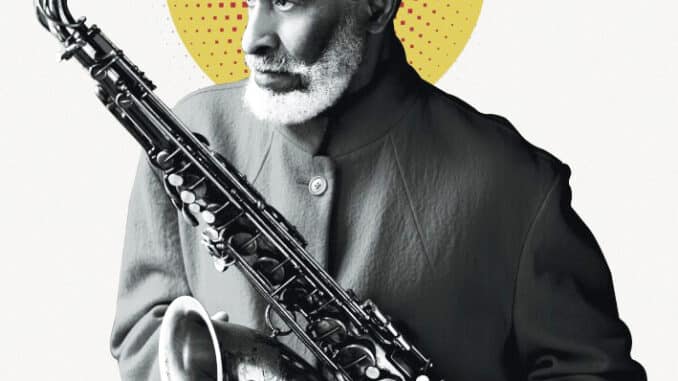

Sonny Rollins, the virtuoso who transformed the art of composing and playing saxophone into masterpieces that rivaled the works of Claude Oscar Monet; the simple complexity of a Romare Bearden collage; and his colored rhythms flowing with the urgency of a Langston Hughes poem, died on May 25, quietly in his home in Woodstock, N.Y. He was 95.
Rollins was a towering titan not only in stature but as a gentleman and master of his instrument — the inventive saxophone colossus, one of America’s great jazz improvisers, who made and restructured jazz history. His solos flew with spiritual intensity, rhythmic tones with bebop tenacity, emotional notes that danced on heartbeats. His sound was the fluid link to his heroes Coleman Hawkins, Lester Young, and Charlie Parker.
The saxophone giant was the last surviving musician in the historic photograph “A Great Day in Harlem,” originally titled “Harlem 1958,” taken by Art Kane on August 12, 1958, in front of the brownstone at 17 East 126th Street. “There were so many great influences in that picture and in my life, like Coleman Hawkins and Lester Young. They inspired a lot of young people like me to understand what it was to play good music. Everybody in that photo made their mark and have moved on,” said Rollins in our interview. “I paid my dues. I’ve done some things I am happy about; some not so much. I’m not perfect but at 94, I will keep trying. Every day means something. It’s another day to get something right. That’s what life is!”
The Harlem native’s last public performance was in 2012 and two years later he retired due to pulmonary fibrosis. In 2024, Resonance Records released a 4-LP box set and 3-CD box set of previously unissued recordings of Sonny Rollins’s European tour in 1959 with bassist Henry Grimes and drummers Pete La Roca, Kenny Clarke, and Joe Harris.
In 2024, six boxes of personal notebooks — his personal archives — that he had donated to the Schomburg Center for Research in Black Culture/NYC Public Library were compiled into a book entitled “The Notebooks of Sonny Rollins” (New York Review Books). He began taking notes on yellow pads during the same time he was practicing nightly on Brooklyn’s Williamsburg Bridge. He merged his bridge experience and writings together; they served as his reflective spaces to ponder resilience, to pursue greater awareness, and to acknowledge and understand that difficulties will be overcome.
The three-time Grammy-winner recorded over 60 albums as a leader and was a welcomed contributor on many acclaimed jazz recordings during his career. As a teenager after graduating from Benjamin Franklin High School in East Harlem, he made his first professional recording with trombonist J. J. Johnson, pianist Bud Powell, trumpeter Fats Navarro, and drummer Roy Haynes. During a radio interview, Rollins was asked if he felt intimidated by playing with such great musicians at that age. He replied, “I had too many stars in my head to be intimidated. I was confident because they asked me to play, but what an experience as a teenager; I played with Roy Haynes and all those guys, what a pleasure.”
Miles Davis asked Rollins to join his band, and recorded three of the young saxophonist’s compositions (now jazz standards) “Oleo,” “Airegin,” and “Doxy” on his album “Bags’ Groove” (1957 Prestige). He later joined with fellow tenor saxophonist Sonny Stitt and Dizzy Gillespie for the album “Sonny Side Up.”
“I met Sonny as a little kid. He was my father’s best friend and, as I became older, he became my mentor. After my father died, he called me regularly just to check in as I became more involved with the music as a saxophonist; he was always available,” said his godson, saxophonist Eric Wyatt. “He was a very important part of my life.”
Rollins’s intuitive playing was instrumental on Thelonious Monk’s album “Brilliant Corners” (Riverside 1956) along with the energetic output of trumpeter Kenny Dorham and Max Roach. He later became a member of the Clifford Brown & Max Roach Quintet, one of the foremost jazz groups in history. Rollins (replacing Harold Land) joined with seasoned group members bassist George Morrow and pianist Richie Powell. Unfortunately, the group ended abruptly with the fatal car accident that took the lives of Brown and Powell in 1956.
Shortly afterward, Rollins began his trio concept of bass and drums without piano. “I didn’t know that would become a big deal,” said Rollins. “For me, the smaller trio without piano just worked better and gave us more space for expression to be completely free.” Years later, his trio format was adopted by Trio 3, which featured Oliver Lake, Reggie Workman, and Andrew Cyrille.
His earlier trio albums include “A Night at the Village Vanguard” (Blue Note 1958). The live recordings featured two separate groups: bassist Donald Bailey and drummer Pete La Roca, and bassist Wilbur Ware and drummer Elvin Jones, respectively. “Way Out West” (Contemporary 1957) found Rollins on the album cover decked out in western gunslinger gear, standing in the desert, the fastest sax from the east swinging with bassist Ray Brown and West Coast drummer Shelly Manne. Rollins had the humor and imagination to swing on the country tunes “I’m An Old Cowhand,” and “Wagon Wheels.” Rollins was a master at reshaping quirky tunes and Great American Songbook standards into hip Harlem jazz joints.
“Sonny was my Godfather, Padrino, Babalawo, Spiritual Guide. He was the living essence of what it means to be a true mentor and guide. He took the title, role, and responsibility seriously to heart,” said saxophonist, composer, and educator Rene McLean. “From around 14 years of age we began having serious conversations about what I call life’s lessons ranging from spirituality, morality, religion, politics, race, culture, Black conscience, music, business of music, his childhood, life and family, growing up in Harlem, etc. was a very rich, life-long relationship.”
Rollins recorded another trio piece, “Freedom Suite” (Riverside 1958), that proved to be the most controversial album of his career. The original liner notes, a few sentences written by Rollins, clearly observed, “How ironic that the Negro, who more than any other people can claim America’s culture as his own, is being persecuted and repressed…” The label pulled the record, and when it was finally reissued four years later, “Freedom Suite” was repackaged as “Shadow Waltz.”
The original cover — of a bare-chested Rollins next to a series of columns spaced just so as to suggest jail bars — was replaced with a tuxedo’d Rollins. Its running order was revamped, Rollins’ liner notes omitted, and his most powerful recorded statement to date was relegated to the B-side (as related in Jazz Times Magazine in 2016). The title track remains a 19-minute beehive of fiery chords with Rollins’ tempo changes and pulsating bop, accompanied by the sizzling telepathy of Max Roach and bassist Oscar Pettiford.
“Why did I do it?” Rollins said to Hilton Als in 2016. “Because I was trying to get Black consciousness into people.” In a letter to the Jazz Times editors, he wrote, “It was an attempt to introduce some kind of Black pride into the conversation at the time, that was my history.”
“Most of the people I met in my lifetime were great people, Miles Davis, Dizzy Gillespie, Charlie Parker, and John Coltrane; these guys had hard lives but they had a spiritual sense in their lives. I think that is the key. I don’t know quite how to say it, but don’t live a jive-ass life. We have to realize there’s more to life than making a name for yourself and making money. It’s a spiritual thing, to treat people the way we want to be treated, that will make a difference. We got to get it right.”