
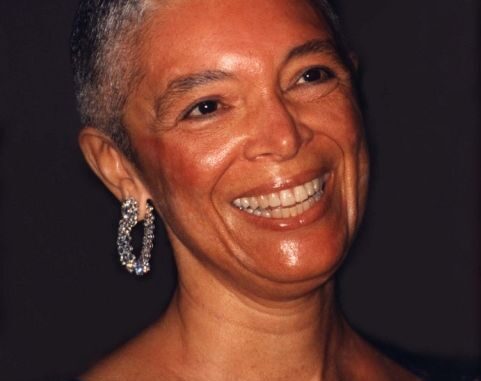
By Stacy M. Brown | Twenty-eight years ago, Camille Cosby wrote a column in a national newspaper that set off a firestorm of controversy. She had just buried her son, Ennis Cosby, killed on a roadside in January 1997. But she did not write quietly, and she did not write small. She wrote about race, about power, and about voting.
Sounding the alarm then, Cosby offered that the Voting Rights Act signed by President Lyndon B. Johnson in 1965 was set to expire in 2007.
“Congress,” she declared, “once again will whether African Americans will be allowed to vote. No other Americans are subjected to this oppressive nonsense.”
That, and the fact that USA Today misrepresented critical wording when they published the piece, drew immediate backlash. Critics across the political spectrum pushed back. Commentators called her claim exaggerated and unfounded. Some argued she had taken a personal tragedy and turned it into a sweeping indictment of the country. Even within Black political circles, including members of the Congressional Black Caucus at the time, there was resistance to how she framed her column.
But, she did not pull back.
“I believe America taught our son’s killer to hate African Americans,” Cosby asserted. She pointed to pointed to what the killer, Mikail Markhasev, said after killing her son. “I shot a nigger. It’s all over the news,” Markhasev bragged.
She viewed that statement as more than a slur. She identified it as evidence of something learned and reinforced.
Cosby argued that Markhasev likely did not learn that hatred in Ukraine, where the Black population was nearly nonexistent. She pointed instead to what he encountered in the United States. She said it wasn’t likely that Markhasev could see America’s “intolerable, stereotypical movies and television programs about Black people, which were not shown in the Soviet Union before the killer and his family moved to America in the late 1980s.”
Cosby also quoted James Baldwin from his book, “The Price of the Ticket,” saying that “The will of the people, or the State, is revealed by the State’s institutions. There was not, then, nor is there, now, a single American institution which is not a racist institution.”
She argued that racism and prejudice are omnipresent and eternalized in America’s institutions, media and myriad entities.
The philanthropist and author laid out her argument in full. Slaveholders honored on U.S. currency. George Washington ($1), Thomas Jefferson ($2), Alexander Hamilton ($10), Andrew Jackson ($20), Ulysses Grant ($50) and Benjamin Franklin ($100). “Grant was the last U.S. president to own slaves,” Cosby noted. “Even Abraham Lincoln ($5) said, ‘I do not stand pledged to the prohibition of the slave trade between the states… I, as much as any man, am in favor of having the superior position assigned to the White race.’”
She pointed out that dictionaries define “Black” as negative and “white” as virtuous. Religious imagery centered in whiteness. Medical experimentation on Black infants. Films that portrayed Black people as less than human. Violence accepted as part of everyday life.
“All African Americans, regardless of their educational and economic accomplishments, have been and are at risk in America simply because of their skin colors,” she wrote.
The criticism Cosby received was sharp and sustained. One response called her argument “not only wrong, but dangerously so.” Another dismissed her conclusion about voting rights as “preposterous.” Even Black members of Congress joined in condemning Cosby.
Twenty-years after that, in a conversation with the Black Press, she returned to the same concerns. “The American people have been dangerously close to being governed by a dictatorship… intent on serving its own greedy interests even, when it results in eradicating the laws that protect humanity,” Cosby remarked just over a year into Donald Trump’s first term as president.
Now, in 2026, the Supreme Court has ruled in Louisiana v. Callais, striking down Louisiana’s second majority-Black congressional district and tightening the standard under Section 2 of the Voting Rights Act.
For decades, Section 2 gave voters a way to challenge maps that split Black communities apart or packed them into a limited number of districts. That tool helped increase the number of Black elected officials from about 1,500 in 1970 to more than 10,000 today.
That tool is now weakened – practically gutted.
States are already preparing to redraw maps. Districts that once allowed Black voters to elect candidates of their choice are about to be dismantled. Members of the Congressional Black Caucus are now bracing for that impact, warning of fewer seats and reduced representation.
“Black Americans have never been fully represented in the electoral process,” Cosby insisted. “This ruling makes it less likely that we ever will. The Supreme Court betrayed Black voters, they betrayed America, and they betrayed our democracy.”
In 1998, Camille Cosby wrote that the right to vote could be placed back in the hands of those who never wanted Black Americans to have it in the first place. Many rejected that warning at the time.
“When,” Cosby asked, “is America going to face its historical and current racial realities so it can be what it says it is?”