

by Frederick Joseph
The first text I saw this morning, the one that told me Jesse Jackson had died, came from my mother.
There was no paragraph. No reflection. No explanation. Just a photograph of him and a text bubble that simply said: RIP.
I do not know that my mother and I have ever sat down and had a formal conversation about Jesse Jackson. I am certain his name has drifted through the house over the years, mentioned in passing, folded into the larger weather of politics and church and memory. But with that photo, she did not have to say anything else. She did not have to explain who he was or why he mattered. The image was enough. Of course I should know who he is automatically. Of course most Black people should know who he is automatically. That is the measure of the man. He was not trivia. He was atmosphere.
You cannot have a conversation about modern Black political power without saying the name Jesse Jackson.
To attempt it would be like telling the story of a river while pretending not to see the bend that helped change its course. He stood beside Dr. King in the 1960s, yes. That is the photograph most people remember. But what distinguished him was not proximity to greatness. It was his refusal to let that greatness calcify into nostalgia. He would not allow the movement to become a museum piece. He carried its fire out of the streets and into the arena of national power, where fire is far less welcome.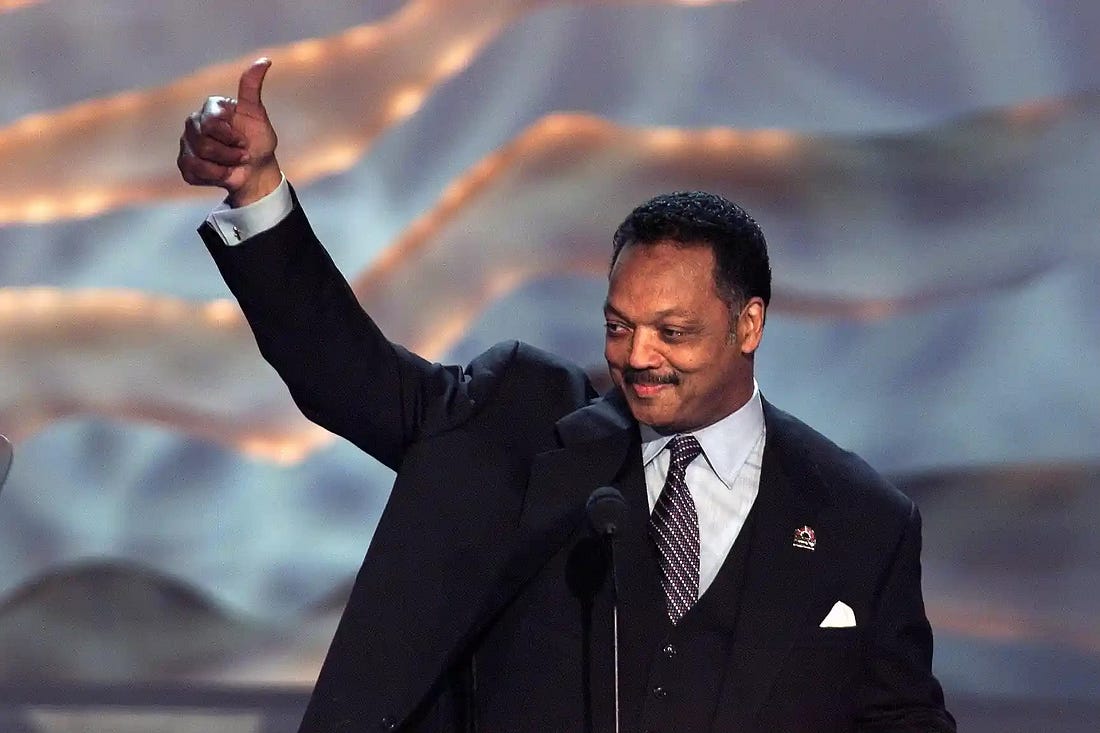
He built organizations. He ran for president when the idea of a Black man doing so seriously was treated as even more of a fantasy or threat. And in doing so, he forced this country to confront a simple fact: we were not petitioning to be included as guests in someone else’s democracy. We were insisting on being recognized as stakeholders in a nation built in no small part by our labor and our blood.
For many Black Americans, he represented something deeply personal. He represented audacity. He represented the belief that our lives, our votes, our labor, and our dreams were not marginal but central to the American story. When he ran in 1984 and 1988, he did more than campaign. He altered the psychological landscape. In living rooms and barbershops and sanctuaries, people who had been told all their lives to lower their expectations watched a Black man compete on a national stage not as a symbol but as a strategist. That shift cannot be quantified in polling data. It can only be measured in the quiet recalibration of possibility inside the minds of children and their parents.
He spoke the language of hope, but it was not a decorative hope. It was not the kind that fits neatly on a bumper sticker. It was organized hope. It was hope that demanded policy, demanded budgets, demanded accountability. He believed poor people deserved power, not pity. He understood that racism, militarism, and economic exploitation were not separate afflictions but braided together in the architecture of the nation. And he said so plainly, even when plain speech cost him favor.
There will be, as there always is, an effort now to smooth him out. To reduce him to a few agreeable phrases. To remember him in ways that do not trouble anyone’s conscience. But Jesse Jackson was never meant to be harmless. He was imperfect. He was controversial. He was human. And yet he was also a bridge between the era of marching and the era of governing, between the pulpit and the ballot box. He helped transform protest into infrastructure.
My mother did not have to write an essay in her text message. She did not have to explain the stakes. The photograph was enough because his life had already done the explaining. It had already imprinted itself on a generation that understood, without rehearsal, what he meant.
To many of us, his life was a reminder that progress is not gifted. It is insisted upon. It is insisted upon by those willing to risk ridicule, willing to endure contradiction, willing to stand in rooms that were not built for them and refuse to leave quietly. His passing closes a chapter, but it does not absolve us of the work that chapter demands we continue.
The photo was enough. The name is enough. And the insistence he embodied remains.
Rest in power, Rev. Jesse Jackson.