
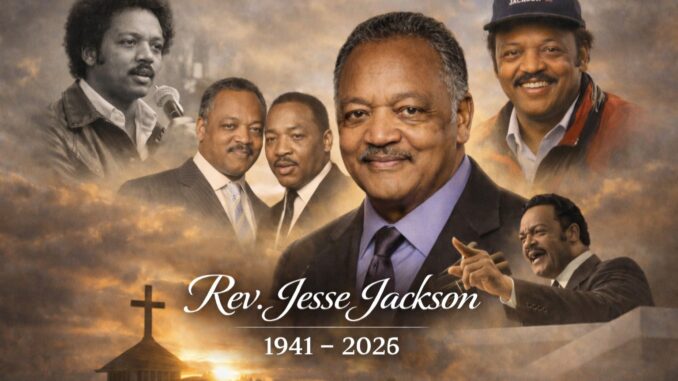
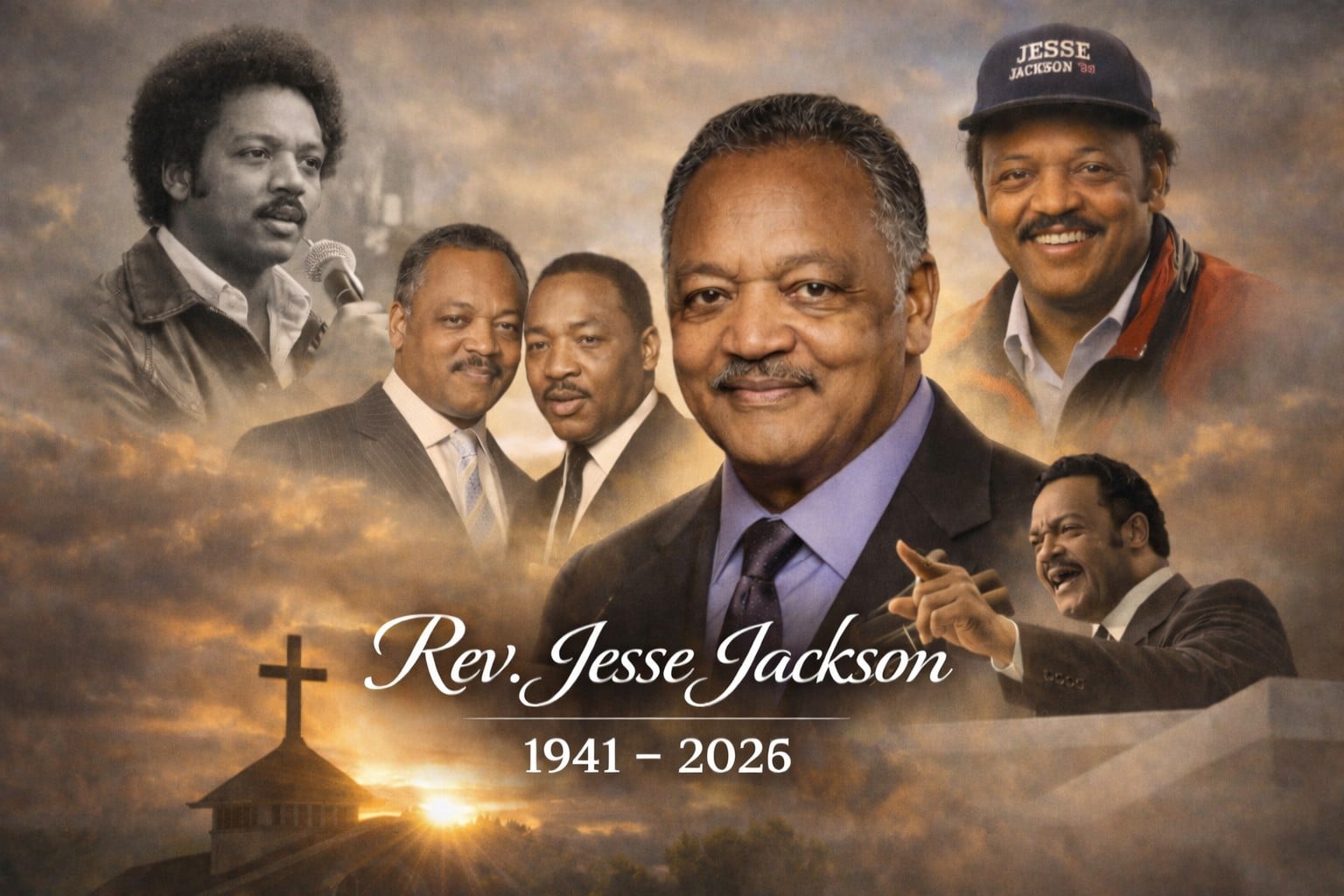
 The Rev. Jesse Jackson, one of the most visible figures in the American civil rights movement and a two-time Democratic presidential contender, passed Tuesday morning at the age of 84. Jackson died peacefully surrounded by family at his home in Chicago the family announced. Officials have not released an official medical cause of death, though he had been struggling with serious neurological illness in recent years.
Jackson’s passing marks the end of a half-century of activism in American public life, from the campaigns for voting rights and economic justice in the 1960s through his groundbreaking bids for the presidency and decades leading organizations like Rainbow/PUSH Coalition.
Born Oct. 8, 1941, in Greenville, South Carolina, Jackson grew up under de jure racial segregation. After graduating from North Carolina A&T State University, he became a key organizer in the Civil Rights Movement. A protégé of Martin Luther King Jr., Jackson took part in major campaigns including the Selma-to-Montgomery marches for voting rights and served as national director of the Southern Christian Leadership Conference’s Operation Breadbasket, pressuring businesses to hire African-American workers.
Following King’s assassination in 1968, Jackson emerged as one of the movement’s most outspoken leaders. In 1971 he founded Operation PUSH (People United to Save Humanity), a Chicago-based advocacy group, which later merged with the Rainbow Coalition to form the Rainbow/PUSH Coalition. The group pressed corporate America and political leaders to address discrimination in employment, education and housing.
He became a national political figure in the 1980s with two presidential campaigns. In 1984 and 1988, his bids for the Democratic nomination helped mobilize millions of Black voters and demonstrated the growing political influence of minorities and progressive constituencies. Although he never secured the nomination, his campaigns left a durable imprint on American electoral politics and helped lay the groundwork for future leaders of color, including Barack Obama.
In his later years Jackson’s public appearances became less frequent as health problems mounted. In 2017 he revealed a diagnosis of Parkinson’s disease, and in 2025 doctors revised his condition to progressive supranuclear palsy (PSP), a rare neurological disorder that affects movement, balance and eye control. He was hospitalized in late 2025 for observation related to complications of PSP and other conditions, but his family said he had been at home in Chicago in his final days. No official medical cause of death has been released.
Jackson was known as much for his oratory as his organizing. His speeches and public remarks conveyed themes of dignity, resilience and hope. Among his widely cited lines:
“If you fall behind, run faster. Never give up, never surrender, and rise up against the odds.”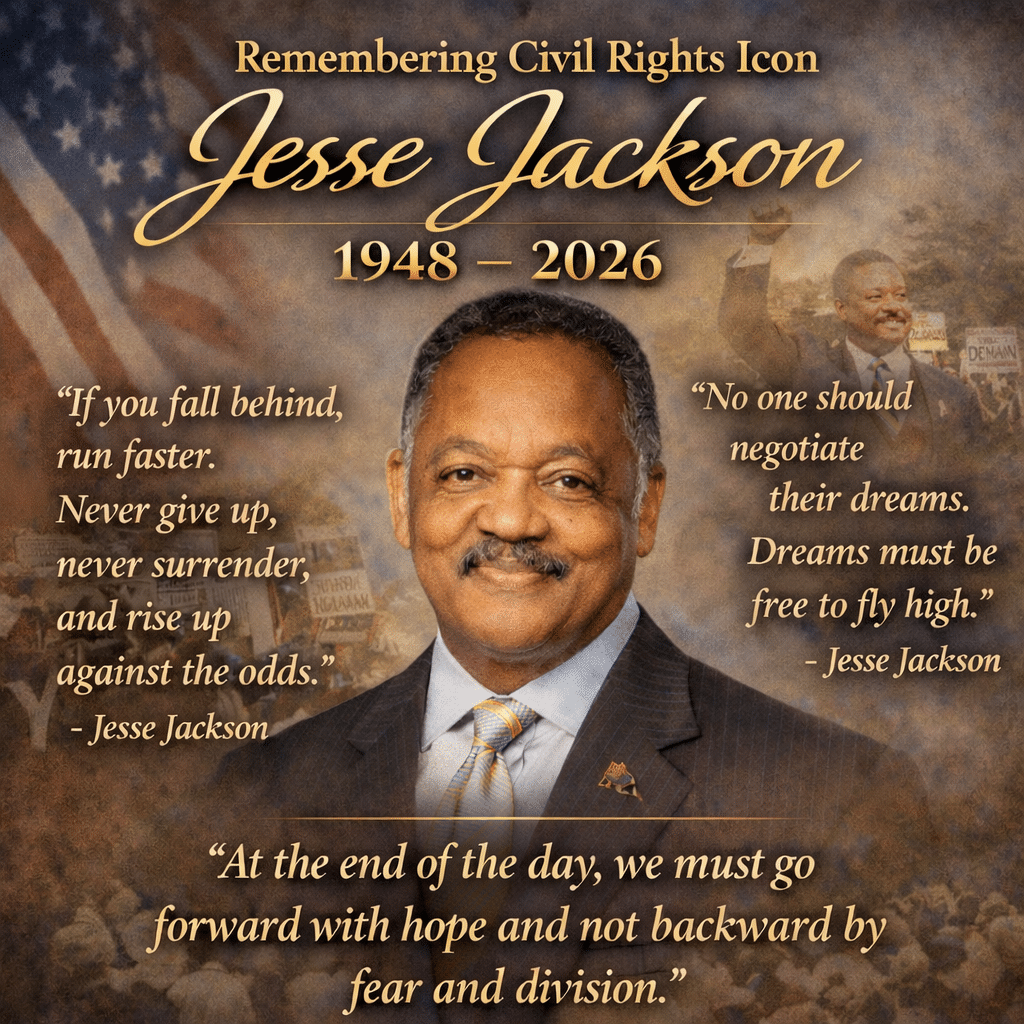
“No one should negotiate their dreams. Dreams must be free to fly high.”
“At the end of the day, we must go forward with hope and not backward by fear and division.”
His family celebrated those values in a statement that described him as a “servant leader” whose “unwavering belief in justice, equality, and love uplifted millions,” and asked that his legacy be honored by continuing the work he championed.
Over decades, Jackson’s work spanned civil rights marches, corporate accountability campaigns, voter registration drives and international diplomacy. Presidents and global leaders acknowledged his influence, and in 2000 he received the Presidential Medal of Freedom, the nation’s highest civilian honor.
His death was met with tributes from across the political spectrum: fellow activists remembered his fight for equality; politicians credited him for helping expand national political participation; and ordinary Americans cited his voice as one that gave courage to those long denied a place at the table of national life.
He is survived by his wife, Jacqueline, their children and grandchildren, and by a movement that many say he helped reshape.