
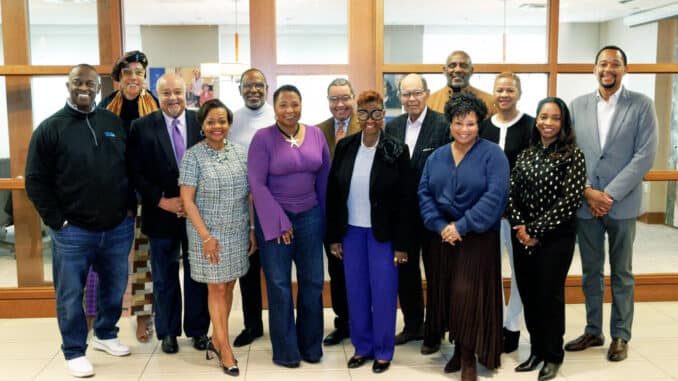
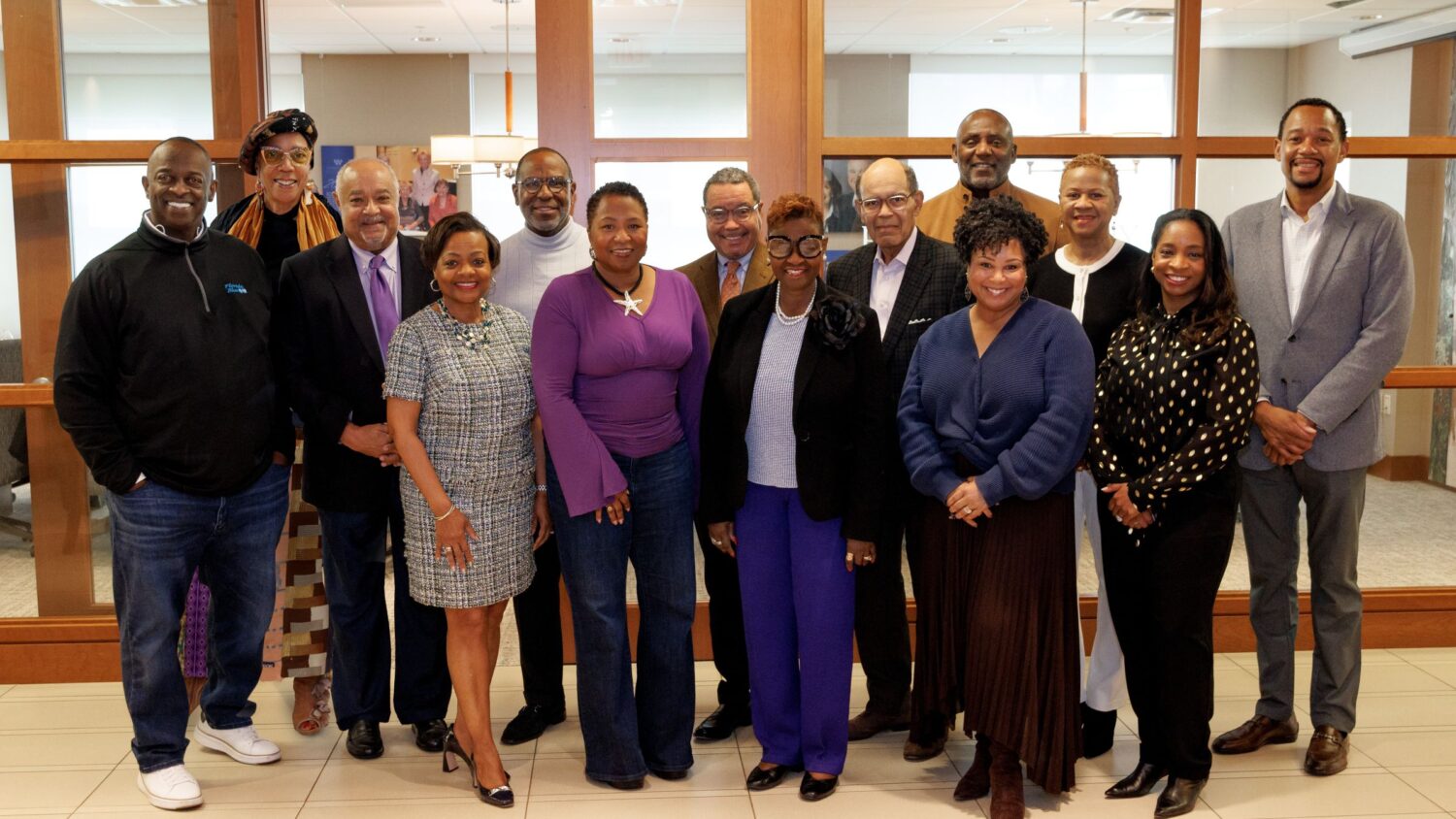
Darnell Smith, Carol Alexander, Brian J. Davis, Wanda Willis, Tim Johnson, Diana Greene, Floyd Willis, Barbara Darby, Joe Louis Barrow, Stacy Ellison, Kelvin Buncum, Pam Buncum, Entrice Rowe, and Glenn Holmes are among the members of the A.L. Lewis Fund.
by Sylvia Perry
In a political moment marked by shrinking public support for organized diversity efforts, the A.L. Lewis Black Opportunity & Impact Fund has emerged as a striking example of community-driven philanthropy aimed at boosting health, education and economic opportunity in underserved neighborhoods of Jacksonville. The fund recently awarded eleven large grants totaling $220,240 to local nonprofits working on those issues, underscoring the critical role of grassroots support in a time of widening political hostility toward diversity and equity initiatives.
Established in 2022 by 22 community stewards under the umbrella of the Community Foundation for Northeast Florida, the A.L. Lewis Fund carries forward the legacy of Abraham Lincoln Lewis, Florida’s first African-American millionaire and founder of American Beach. Since its inception, the fund has distributed more than $600,000 to organizations focused on tackling barriers to opportunity within select ZIP codes across Jacksonville.
The latest round of large grants will support a wide range of neighborhood-level work, including health care access, career readiness and economic empowerment programs. Recipients include the Boys and Girls Clubs of Northeast Florida, Agape Community Health Center, Girls Inc. of Jacksonville and the YMCA of Florida’s First Coast.
“At a time when local nonprofits are navigating unprecedented complexity, local philanthropy has never been more essential,” said A.L. Lewis Fund Chair Tim Johnson. “Together with our members and donors … we are advancing education, healthcare and economic opportunity — not as ideals, but as imperatives for community stability and generational wellbeing.”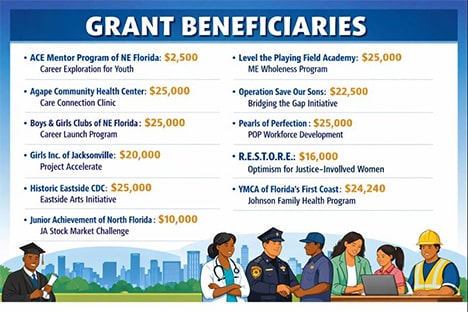
The work of the A.L. Lewis Fund stands in contrast with broader political currents that have made it increasingly difficult for organizations serving primarily African-American and other marginalized communities to secure institutional support.
Across the country and in Florida, state governments have enacted a series of laws and rules limiting the use of public resources for diversity, equity and inclusion (DEI) programs. Critics argue these policies disproportionately affect efforts to address racial inequities in education, employment and health.
In Florida, Gov. Ron DeSantis and the Republican-led Legislature have moved aggressively to restrict DEI efforts at public colleges and universities. In 2023, the Legislature passed Senate Bill 266 (SB 266), which, among other provisions, bars state universities from spending state dollars on programs defined as DEI or certain race-based content — a law that took effect July 1, 2023.
Floridians have seen additional steps taken by state education authorities. The State Board of Education adopted a rule prohibiting the use of public funds for DEI programs at the state college level, effectively ending support for initiatives that categorize individuals by race or gender for preferential treatment.
More recently, the Florida Board of Governors and state leadership announced actions to cancel or repurpose more than $33 million in previously designated DEI-related grants at public universities — redirecting funds from race-focused programs to initiatives defined in broader, race-neutral terms. Examples include rescinding a $1.5 million engineering curriculum grant centered on anti-Black racism and a $1.3 million grant aimed at fostering inclusive classroom cultures.
Supporters of these measures argue they eliminate what they describe as “woke ideology” from taxpayer-funded institutions. Opponents contend the moves chill efforts to tackle systemic inequality and narrow the scope of public funding for historically marginalized communities.
At a time when public funding streams are constricting for programs centered on racial equity, the growth of the A.L. Lewis Fund reflects sustained private and community support for organizations rooted in Black and underserved communities.
Local advocates say the significance of this philanthropic model goes beyond dollars: it represents a collective commitment to invest in communities that are too often overlooked in public policy debates. By pooling resources through membership and collective giving, donors are creating a reliable funding pipeline for critical services — from health clinics to after-school programs — at a moment when some government funding is under political siege.
“Local philanthropy is more than charity,” said one nonprofit leader. “It’s a statement about who we value and whose futures we are willing to invest in.”
As debates over DEI and public funding continue to unfold in Tallahassee and across the nation, the A.L. Lewis Fund’s recent grants signal a resolute effort by communities in Jacksonville to support and sustain organizations that have long been on the frontlines of equity work.
#cfjacksonville